4 min read
Does Google Trends show search volume? How to get real numbers
Google Trends shows interest from 0 to 100, not searches. Here's what the number means, and where to get monthly search counts.

Contents
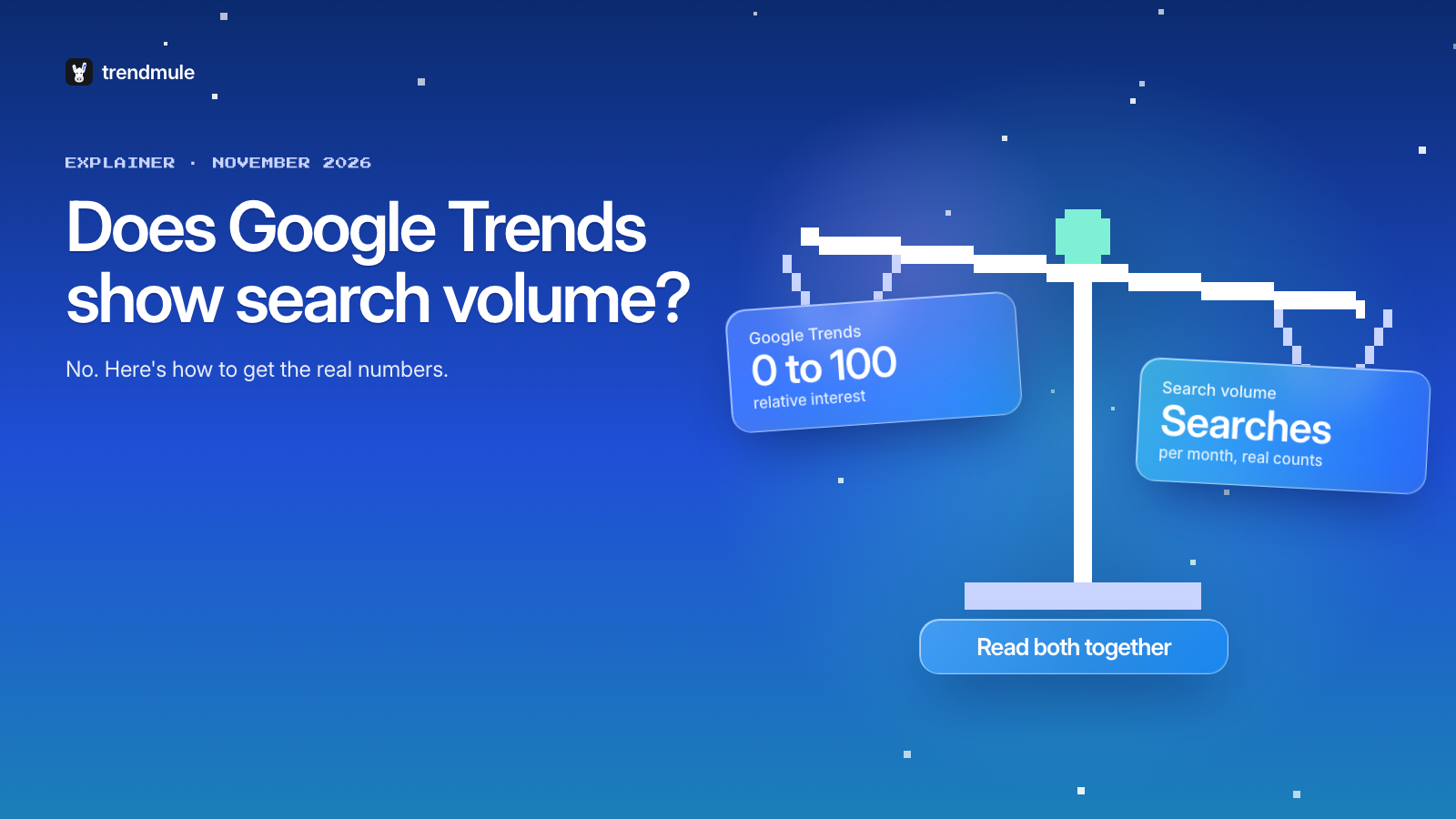
No. Google Trends doesn't show search volume. It shows relative interest on a scale from 0 to 100, where 100 is the peak of the chart you're looking at. Google says each data point is divided by all searches in that place and time, then scaled from 0 to 100, so the score compares popularity rather than counting searches (Google Trends Help). To get real monthly numbers, you need a keyword tool that reports search volume, then you read the two together.
Volume tells you how big a search is. Google Trends tells you which way it's going. A decision needs both.
What does the Google Trends number mean?
The Google Trends number is a share of the chart's own peak. 100 is the highest point in that view; 50 is half as much interest as the peak; 0 means too little data. The number is relative to all searches in that place and time, so it measures popularity, not traffic.
Two consequences matter in practice:
- The same score can hide very different sizes. A niche term at its peak and a huge term on a quiet day can both read 100.
- Scores from different charts can't be compared. Change the country, the dates or the comparison terms, and the whole line rescales.
Can you estimate search volume from Google Trends?
Only roughly, and only if you already know the real number for one term. Put a term with a known monthly volume on the same chart as your term, then scale yours by the ratio of their scores. If the known term reads 50 and yours reads 25, yours is about half as big.
It's fragile. Rounding to whole numbers wipes out small terms, Google Trends uses a sample of searches, and the estimate breaks as soon as one term has a spike. Use it for a ballpark, not for a business case.
Where can you get real search volume?
Each source answers a different part of the question:
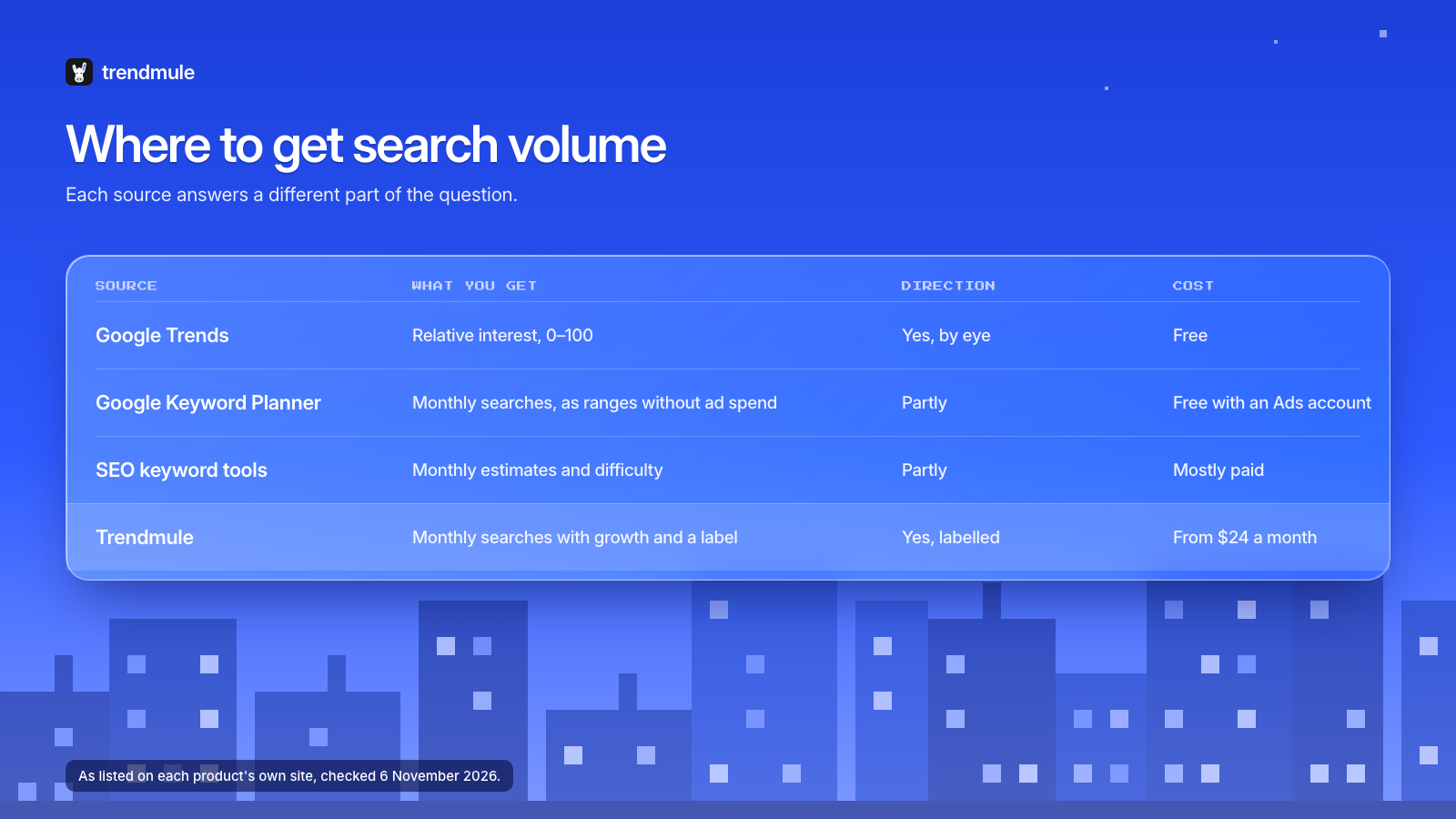
- Google Trends: relative interest from 0 to 100, free, no account. Direction yes, size no.
- Google Keyword Planner: monthly searches, free with a Google Ads account. Accounts that don't run ads often see broad ranges instead of exact figures, as Search Engine Land reported when the change began.
- SEO keyword tools: monthly estimates plus a difficulty score, mostly paid.
- Trendmule: monthly searches with growth and a label that says whether each search is still rising, from $24 a month, as of November 2026.
Why do you need volume and direction together?
Volume without direction rewards the past, and direction without volume rewards noise. A big search can be shrinking fast: in Trendmule's US Google search data for August to October 2026, Dubai chocolate was still a large search but down 48% on a year earlier. A small search can be growing fast and still be too small to matter.
Read them as a pair:
- Big and rising: competitive, but worth it if you can rank or sell.
- Small and rising: the early-mover zone. Padel racket searches were up 171% on a year earlier in the same data, from a modest base.
- Big and flat: steady demand, already served. Good for evergreen pages.
- Any size and falling: leave it unless you already rank.
Our guide on how to read search trends shows how to tell a rise from a spike or a season.
How does Trendmule show search volume?
Trendmule is a dashboard of rising Google searches for creators and app makers. It shows each rising search with its monthly volume and its growth on one row, labelled by whether it's still climbing, so you see size and direction without moving between two tools.
Start from a country and a topic, and the list shows what's gaining speed there. Pro adds two years of history and up to 50 App ideas, as of November 2026. See Google Trends alternatives for how it compares with other tools, or how to use Google Trends if you're sticking with the free chart.
What should you watch out for in any search volume number?
- Every volume is an estimate. Different tools disagree, sometimes by a lot, because they sample and model differently.
- Monthly averages hide seasons. A yearly average of a Christmas search tells you little about December.
- Volume lags. Monthly figures arrive weeks after the month ends, so a fresh jump can be missing.
Questions people ask
Does Google Trends show the number of searches?
No. Google Trends shows relative interest from 0 to 100, scaled to the peak of the chart. It never shows how many searches a term gets.
What does a score of 100 mean in Google Trends?
It's the highest point of interest in that chart, for that place and time range. A score of 50 means half as much interest as the peak.
Is Google Keyword Planner free?
Yes, with a Google Ads account. Accounts that don't run ads often see search volume as broad ranges rather than exact numbers.
How do I find the search volume of a keyword for free?
Use Google Keyword Planner with a Google Ads account for monthly ranges, and Google Trends for direction. Paid tools show exact estimates.