5 min read
How to read search trends and tell if one is still rising
Four shapes every search trend takes, what each one means for you, and how Trendmule labels them so you don't have to guess.

Contents
To read a search trend, look at its shape over time, not its height on one day. Every search trend takes one of four shapes: a steady climb, a sudden spike, a yearly wave or a slow slide. Only the first is new demand worth building for. Trendmule reads the shape for you and labels every search Trending, Sticking around, Always popular or Fading, in every country and region.
This guide covers the four shapes, how to compare searches, and the mistakes that make a trend look better than it is.
What does a search trend show?
A search trend shows how interest in a search changes over time, in one place. It answers "is this growing?", which matters more than "is this big?", because demand that's growing is demand nobody has fully served yet.
Most trend charts show interest relative to the search's own peak rather than a count of searches, so the line's shape carries the meaning. A line at its highest point today and a line at its highest point a year ago can look the same; only the dates tell you which one is still worth acting on.
What are the four shapes of a search trend?
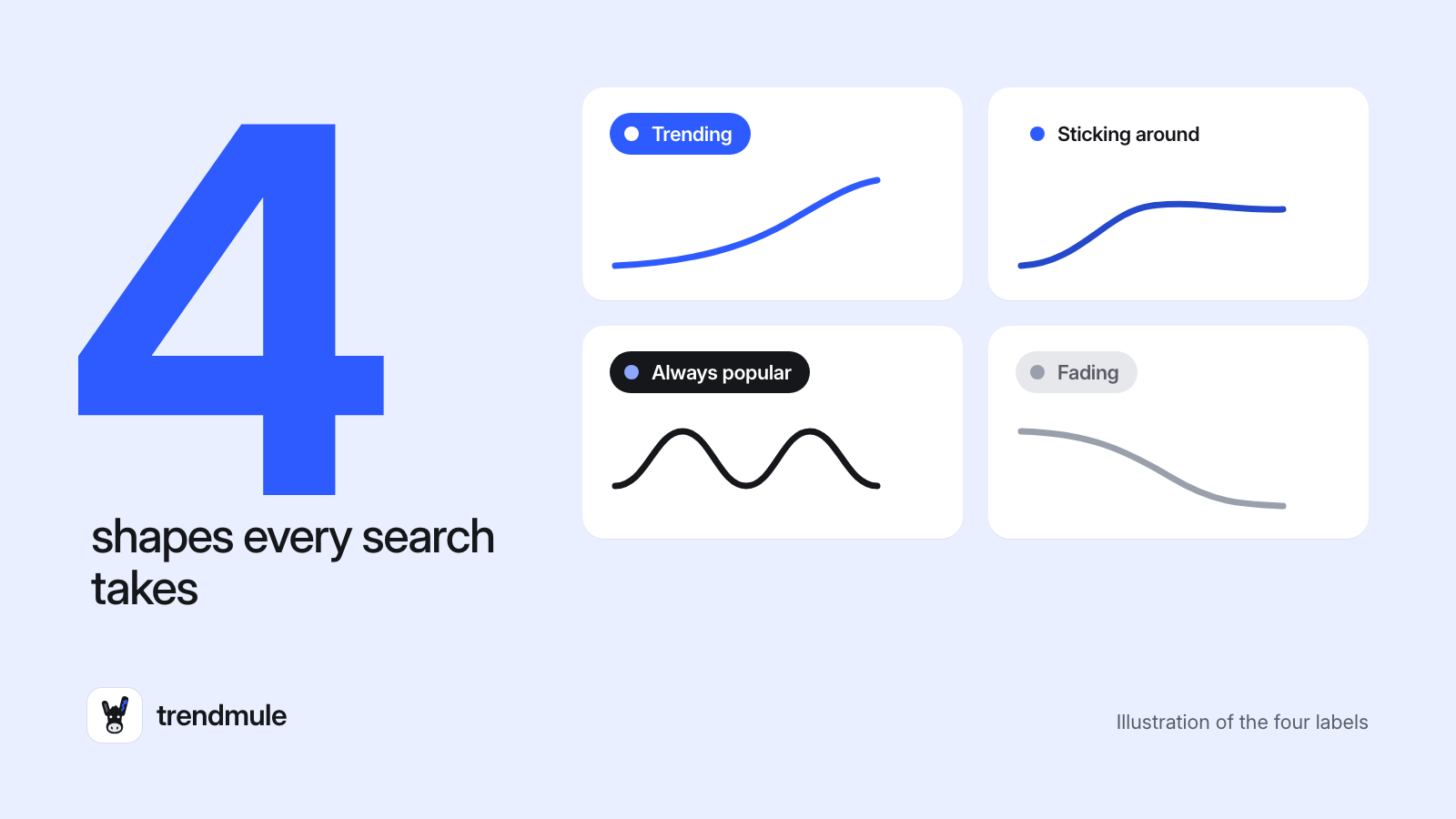
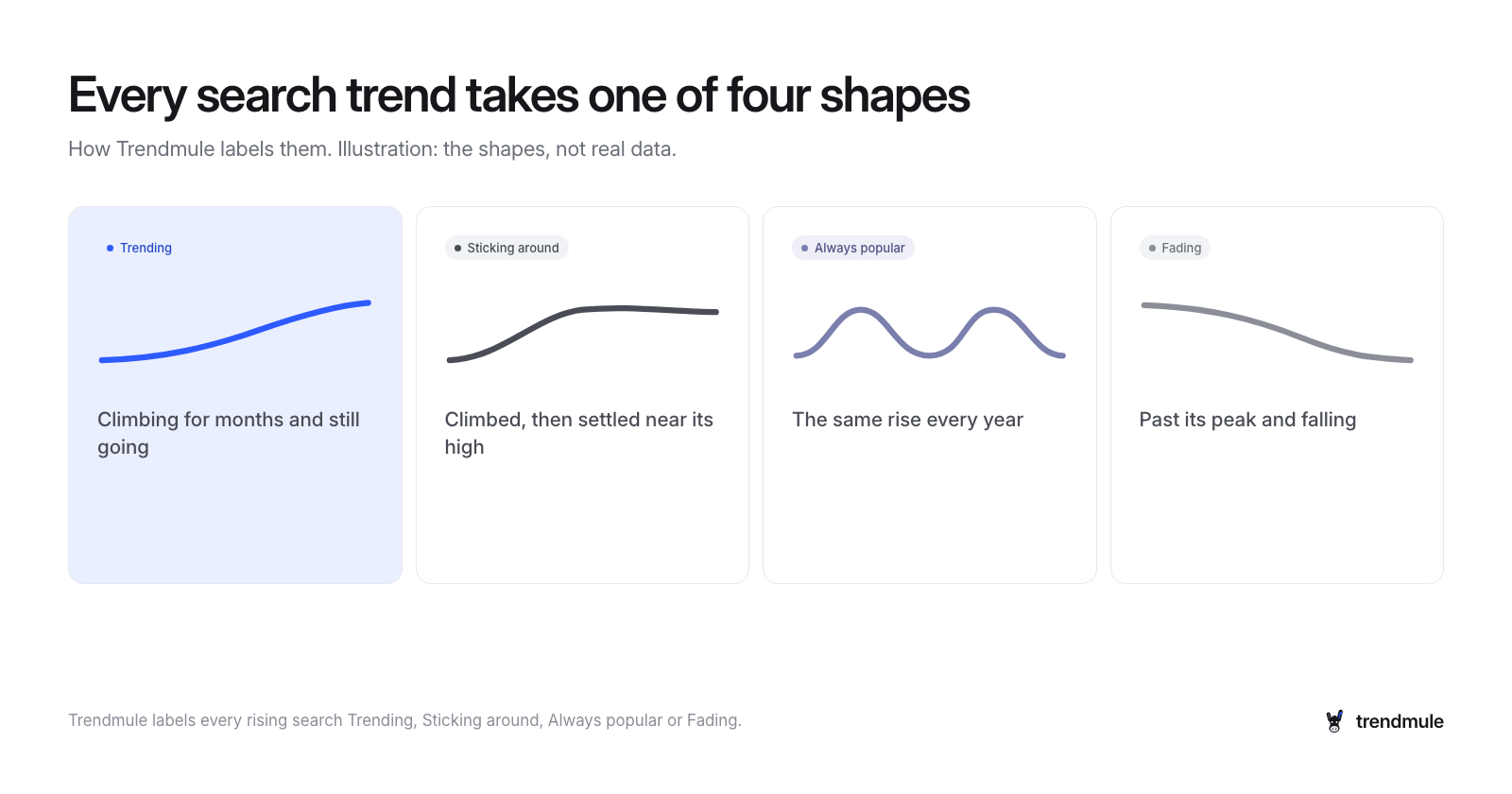
- Steady climb: interest rises for months and keeps going. New demand, and the shape worth building for. Trendmule labels it Trending.
- Plateau: interest climbed and now holds. The demand has settled; there's still room, with more competition. Trendmule labels it Sticking around.
- Yearly wave: the same rise every year, such as gifts in December or sunscreen in June. Plan it like a calendar event. Trendmule labels it Always popular.
- Slide: interest peaked and is falling. The crowd is leaving. Trendmule labels it Fading.
A spike that rises and falls within weeks is a news moment or a fad. It can be worth a fast post, never a product.
How do you tell a lasting trend from a fad?
Look at the history, not the last month. A lasting trend climbs for months and holds; a fad climbs in weeks and falls almost as fast.
A big peak looks like a big opportunity, but most of a peak's demand has already been met by whoever arrived first, which is why a smaller search that's still climbing is often the better bet. In Trendmule's Google search data checked on 2 October 2026, US searches for Labubu were down 94% on a year earlier, Dubai chocolate 74% and wall pilates 67%. All three looked unstoppable at their top.
Trendmule keeps up to two years of history on Pro, so you can see the whole shape before you commit. Our research on when to jump on a trend, and when to get off shows how fast fads rise and fall, and each plan's features are on our homepage.
How do you compare two search trends?
Put both searches on the same scale and compare their shapes, not just their heights. If one is climbing and the other is flat, the climbing one is the better bet even if it's smaller today.
Add a search you already understand as a yardstick, such as a brand or a big topic in your niche. An unfamiliar search next to a known one suddenly has a sense of size. Trendmule ranks rising searches by momentum, so the comparison you'd otherwise build by hand is the list itself. If you're weighing tools for this, see Google Trends alternatives.
Where is a search trend rising?
A trend can be rising in one country and flat in yours, or rising in one region before it spreads. Check where demand comes from before you plan around it.
Trendmule covers every country down to the region on every plan, so you can see whether a search is a national trend, a regional one or one that hasn't reached your market yet. A trend that's climbing elsewhere and not yet at home is often the earliest signal you'll get.
What mistakes make a search trend misleading?
- Reading height as size. A peak shows the busiest point for that search, not how many people searched.
- Reading the past as the present. A search that climbed last quarter can be fading today.
- Ignoring the season. A November climb might be the same December wave as every year.
- Ignoring the place. A trend in one country says little about another.
Each mistake has the same fix: check the label, the history and the region before you act. To put this to work, read how to find trending keywords. If you also want the rising searches that fit your own site, the Website Tracking Tool starts from your website instead of a keyword.
Questions people ask
How do you know if a trend is still rising?
Look at its history over months, not days. A steady climb that keeps going is still rising. Trendmule labels every search Trending, Sticking around, Always popular or Fading, so you see it at a glance.
Does a trend chart show search volume?
Usually not. Most trend charts show interest relative to a search's own peak, so the shape over time carries the meaning, not the height of the line. See does Google Trends show search volume.
What's the difference between a trend and a fad?
A trend climbs for months and holds. A fad climbs in weeks and falls almost as fast: US searches for Labubu fell 94% in a year, in Trendmule's Google search data, 2 October 2026.
What is a seasonal trend?
A seasonal trend rises at the same time every year, such as gifts before December. Trendmule labels these Always popular, so you can plan pages and stock before the yearly climb starts.