8 min read
How to find trending keywords: 7 free and paid ways
Trendmule, Google Trends, Trending Now, autocomplete, YouTube, Reddit and keyword tools. What each one shows, and how to check a keyword is still rising.

Contents
To find trending keywords, use a source that shows searches growing right now, then check each one is still rising before you publish. The seven ways that work: Trendmule, a dashboard of rising Google searches by country and topic, then Google Trends Explore, Google's Trending Now page, search autocomplete and "People also ask", YouTube search suggestions, Reddit, and keyword tools with monthly history. Trendmule and keyword tools show direction over months; the five free sources show phrasing.
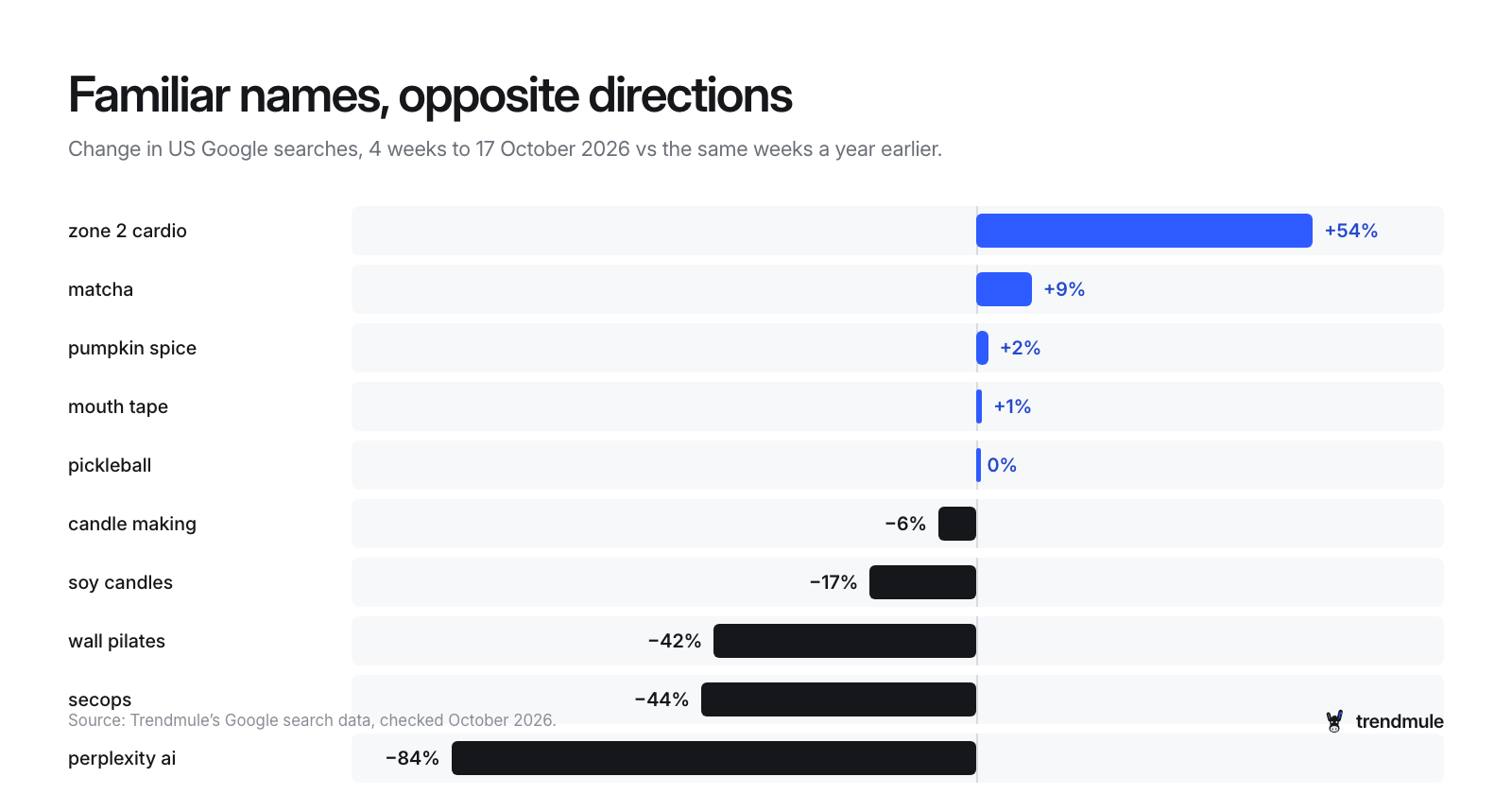
A keyword that's trending today can already be at its top. US searches for Labubu are down 94% on a year earlier, in Trendmule's Google search data checked on 2 October 2026, and it was on every trending list at its peak.
What is a trending keyword?
A trending keyword is a search whose interest is growing faster than usual, in a given place and period. It's different from a popular keyword: "weather" is popular every day, while a trending keyword wasn't popular a few weeks ago and is climbing now.
The useful kind is still rising, not already peaked. A page or a video made while searches climb meets a growing audience; the same work after the peak competes for a shrinking one.
What are the 7 ways to find trending keywords?
Each source answers a different question. Trendmule starts from your market and shows direction; the free ones add phrasing and ideas.
1. Trendmule
Trendmule is a dashboard of rising Google searches for content creators and app makers. You pick a country and a topic, and it lists the searches gaining speed there, ranked by momentum, with no keyword to type first.
- A label on every search: Trending means still climbing, Sticking around means holding, Always popular means steady every year, and Fading means past its best.
- History and regions: up to two years of history on Pro, and where in a country the demand comes from.
- Alerts and export: niche alerts tell you when your niche moves, and any view exports to CSV.
If you have a website, the Website Tracking Tool (beta, Pro) finds the rising searches that fit it. If you work with an AI assistant, the MCP server lets Claude or Cursor ask what's rising for you.
2. Google Trends Explore
Google Trends Explore is free and shows how interest in a search has changed, on a scale from 0 to 100. Type a topic, set the country and the past 12 months, then open Related queries and switch to Rising. Those are the searches growing fastest around your topic, so this is the quickest free way to turn one idea into a list.
The limit is that you need a starting word, and the score is relative, not a count of searches. Our guide on how to use Google Trends walks through it, and does Google Trends show search volume explains the 0 to 100 score.
3. Google Trending Now
Google's Trending Now page lists the searches surging in a country over the past few hours to seven days. It's free and needs no starting word, which makes it good for news, sport and launches.
Most of what appears there is a spike that ends within days. Use it for fast content, not for a guide you want ranking next year.
4. Search autocomplete and "People also ask"
Start typing your topic into Google and note the suggestions. New phrases there are being searched often, in the words people really use. The "People also ask" box adds the questions people attach to a topic, which make good headings.
Autocomplete shows phrasing, not direction, so it can't tell you whether a phrase is growing or shrinking.
5. YouTube search suggestions
YouTube's search bar autocompletes the same way as Google, from what people search on YouTube. For fashion, beauty, food and gaming, new phrases often show up there before they spread to Google. Our post on YouTube trends shows how search and video trends compare.
6. Reddit and forums
Search your topic on Reddit and sort by new or by top this week. Questions that keep coming up, in people's own words, are early keywords. Forums show why people search, which no chart does.
The catch is time: it's manual, and a busy thread doesn't always mean a busy search.
7. Keyword tools with monthly history
Paid keyword research tools show estimated monthly searches and, in most of them, a history of the past one or two years. Sort by growth instead of size and you get keywords that are both rising and big enough. They answer the "how many people?" question Google Trends can't.
They usually start from a word you type, so they help you size an idea more than find one.
Which way should you use?
Pick by the question you need answered:
- Trendmule: paid, from $24 a month; rising searches by country and topic, labelled by whether they're still climbing.
- Google Trends Explore: free; turns one topic into rising related searches; needs a starting word.
- Trending Now: free; today's spikes in a country; most fade within days.
- Autocomplete and "People also ask": free; real phrasing and questions; no direction.
- YouTube suggestions: free; early for visual and video-first topics; phrasing only.
- Reddit: free; the reasons behind searches; slow and manual.
- Keyword tools: paid; search counts and history; start from a word you type.
Free sources are enough to find phrases. Checking that a phrase is still rising, every week, is where a paid tool earns its cost.
How do you check a trending keyword is still rising?
Three checks before you write, film or stock anything:
- History. Look across months, not days. A climb that repeats every November is seasonal; a climb that started this spring and keeps going is new demand.
- Place. A search rising in one region or country might not be rising in yours.
- Fit. The trending keyword worth chasing is one your shop, channel or app can credibly answer. A rising search you can't serve is someone else's opportunity.
Trends that look unstoppable turn quickly. US searches for wall pilates are down 67% on a year ago, in Trendmule's Google search data checked on 2 October 2026. Our guide on how to read search trends shows the four shapes to look for.
How do you find the top searched keywords on Google?
The top searched keywords on Google are mostly brand names people type instead of a web address: ChatGPT, Amazon, YouTube and Gmail led the 100 big US searches Trendmule tracked for August to October 2026. They're useful for knowing what people do every day, and almost useless as keywords, because the brand's own site takes the clicks.
To find the top keywords in your own niche, narrow to a topic and a country first, then sort by growth instead of size. Our monthly list of the top 10 Google searches and which are still rising shows the full ranking.
How do you use trending keywords once you find them?
Match the format to the speed of the trend:
- A fast spike (days or weeks): a short video, a social post or a quick product listing. Publish within days or skip it.
- A steady climb (months): a full guide, a product page or a new product. This is where most long-term traffic is.
- A yearly wave: plan it like a calendar event, and publish four to six weeks before the climb starts.
Put the keyword in the page title and the first lines, answer the question it implies in plain words, and update the page when the label changes. For a business site, keyword research for small business shows how to map each keyword to a page. Our post on when to jump on a trend, and when to get off shows how fast rises and falls can be.
What are the trade-offs of chasing trending keywords?
- Trends end. A page built on a fad loses its traffic when the fad does, so mix trending keywords with steady ones.
- Speed costs polish. Publishing fast means less time to make the definitive page, and the definitive page usually wins in the end.
- Small numbers at first. A keyword that's rising early has few searches today; you're betting on direction, not size.
Weekly publishers get the most from trending keywords; if you publish twice a year, the free sources above will do. See Trendmule's plans if trends are part of your weekly work.
Questions people ask
How do I use Google Trends to find keywords?
Open Explore, type your topic, set the country and the past 12 months, then open Related queries and choose Rising. Those are the searches growing fastest around your topic.
How do I find trending keywords on YouTube?
Type your topic into YouTube's search bar and note the suggestions. They come from what people search on YouTube, and new phrases there often appear before they spread to Google.
What's the difference between trending and popular keywords?
Popular keywords are searched a lot all the time. Trending keywords are growing faster than usual right now, and the useful ones are still climbing rather than at their peak.
How often should I look for trending keywords?
Weekly, if you publish or launch products often. Labubu went from its first real climb to its peak in about nine weeks in 2025, in Trendmule's US Google search data.
Are trending keywords good for SEO?
Yes, when you publish while the search is still rising and the topic fits your site. Pages published early can rank before competitors arrive.
Updated 16 November 2026