6 min read
When to jump on a trend, and when to get off
Fads rise in weeks and fall just as fast. Lasting searches hold. Timing decides which one you're betting on.

Contents
The best time to jump on a trend is while searches are still climbing. The best time to get off is before the crowd leaves. In Trendmule's Google search data, Labubu went from its first real climb to its peak in about nine weeks in 2025. Three months after that peak, US searches were at half of it. A year later, they were at 5%.
That matters because most people find a trend when it already feels everywhere, which is close to the top. This post shows how fast five well-known searches rose and fell, how a fad differs from a search that lasts, and when to get out.
Why does timing matter more than the trend itself?
Timing matters because the same trend pays very differently depending on when you arrive. A video, a product or a page made while searches climb meets a growing audience. The same thing made after the peak competes for a shrinking one, against everyone who got there first.
US searches for Labubu are down 94% on a year ago, Dubai chocolate 74% and wall pilates 67%, according to Trendmule's Google search data checked on 2 October 2026. All three were impossible to miss at their peak. None of them is a good bet to start on today.
How fast do trends rise?
Fads rise in weeks, not months. In Trendmule's US Google search data:
- Labubu took about nine weeks, from mid-April to its peak in the week of 15 June 2025.
- Dubai chocolate took about three months, from late November 2024 to its peak in the week of 2 March 2025.
- Wall pilates peaked in the week of 29 December 2024, when New Year's resolutions sent everyone searching at once.
A window of a few weeks is shorter than most planning cycles. By the time a product is ordered or a content calendar is approved, a fast fad can already be at its top.
How fast do trends fall after the peak?
Fads fall almost as fast as they rise. The chart shows each search as a share of its own peak, month by month after it.
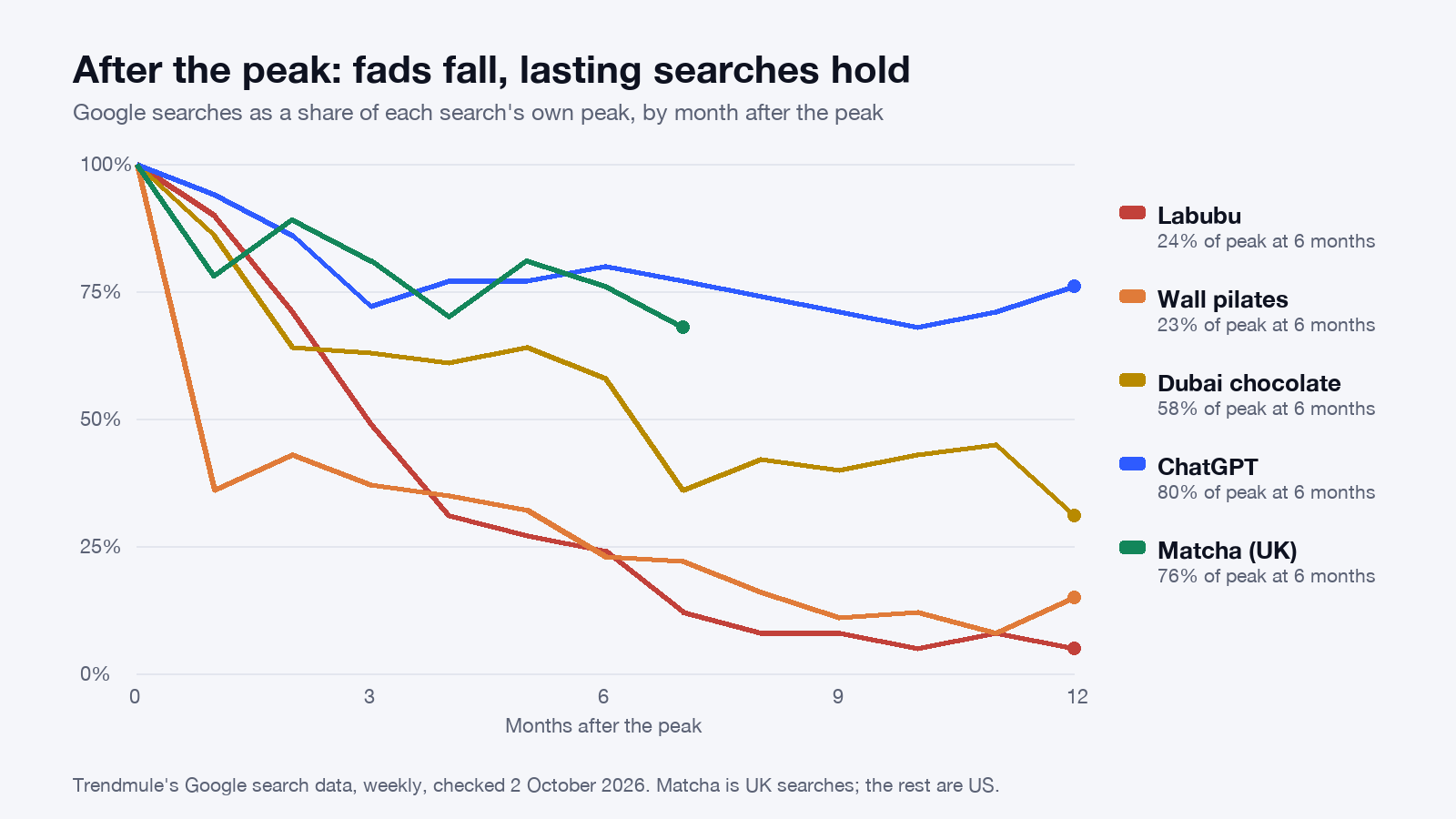
- Wall pilates dropped to 36% of its peak within a month.
- Labubu was at 49% of its peak after three months, 24% after six and 5% after a year.
- Dubai chocolate fell slower, to 58% after six months and 31% after a year.
The searches that last look different. Six months after their peaks, ChatGPT was still at 80% of its peak in the US and matcha at 76% in the UK. A year after its peak, ChatGPT was at 76%.
Why is "everyone's talking about it" the worst time to start?
"Everyone's talking about it" is the worst time to start because that moment is usually the peak. A search only feels everywhere once most of the people who'll ever search for it already are. What's left after that is the fall.
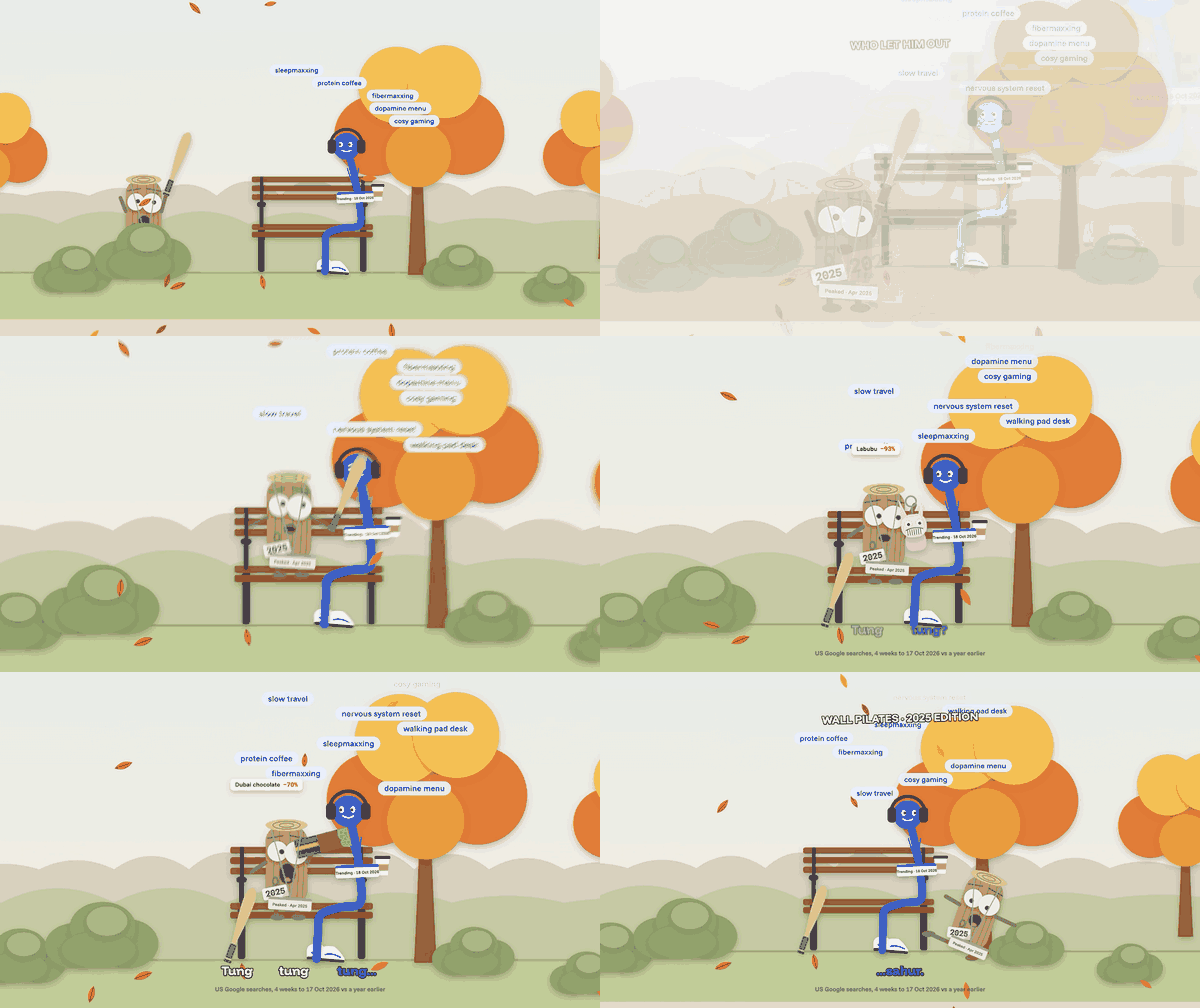
The clip above is the whole problem in eight seconds. Last year's trend still acts like it's the moment, while the searches people are actually making have moved on. Relevance has a date on it, and audiences notice when it's out of date.
How do you tell a fad from a search that lasts?
A fad rises and falls fast. A lasting search climbs and then stays near its high. The clearest sign is what happens after the peak: Labubu lost half its searches within three months, while ChatGPT and matcha were still close to three-quarters of their peaks six months on. Our guide on how to read search trends covers the four shapes a search can take. For apps, the same test applies to an app idea: a rise that has lasted more than a month is a better base than a one-month jump.
Trendmule puts a label on every search so you don't have to read the curve yourself:
- Trending: still climbing. The time to make something.
- Sticking around: past the steepest climb, but holding. Still worth making for, with less of a head start.
- Always popular: steady demand year after year. Good for evergreen pages, not for being first.
- Fading: past its best. Finish what you've started, but don't launch anything new for it.
When should you get off a trend?
Get off a trend once it's clearly fading, not when it disappears. By the time searches are near zero, the money and attention are long gone.
Getting off doesn't mean deleting anything:
- Stop launching new things for it. No new product lines, videos or ad campaigns.
- Keep what already works. A page that still brings in visits can stay up.
- Move the effort. Put the next month's budget into a search that's still rising.
What is rising right now?
Some searches are still on the way up. US searches for GLP-1 are up 61% on a year ago, according to Trendmule's Google search data checked on 2 October 2026. Creatine shows the other side: it hit its high in April 2026 and is now at about half of it.
Neither is a sure thing. A rising search tells you where attention is heading, not how long it will stay, which is why checking again next month matters as much as checking today. How to find trending keywords before they peak turns that into a weekly routine.
How we did the research
We took Trendmule's weekly Google search data for five searches over two years: Labubu, Dubai chocolate, wall pilates and ChatGPT in the US, and matcha in the UK. For each one we found its peak week and compared every later month with that peak. Data checked on 2 October 2026.
Questions people ask
How long do trends last?
Fads can rise and fall within a year. In Trendmule's data, Labubu's US searches were at 5% of their peak a year after it. Lasting searches like ChatGPT were still at about three-quarters of their peak a year on.
When is the best time to jump on a trend?
While searches are still climbing, before the trend feels everywhere. Labubu's climb to its peak took about nine weeks in 2025, so the window to get in early can be short.
How do I know if a trend is already over?
Look at what searches did after their peak. If they've fallen most of the way and keep falling, the trend is fading. Trendmule labels every search Trending, Sticking around, Always popular or Fading, so you can see it at a glance.