7 min read
How to find and validate an app idea with search data
Find app ideas people already search for, see who has built them, and learn what's still unproven before you write code.
Contents
To validate an app idea with search data, look for a search that looks like an app, is still rising, and has few established apps named for it. Trendmule, a dashboard of rising Google searches, does this check in its App ideas list: it ranks rising searches that look like apps and shows, for each one, how many apps on the App Store are named for it, how strong they are and what isn't proven yet. It shows where an app could fit. It can't tell you people will pay.
This guide shows how to read an idea in that list, how to use it to find a niche for a new digital product, and what to check before you build.
What is App ideas in Trendmule?
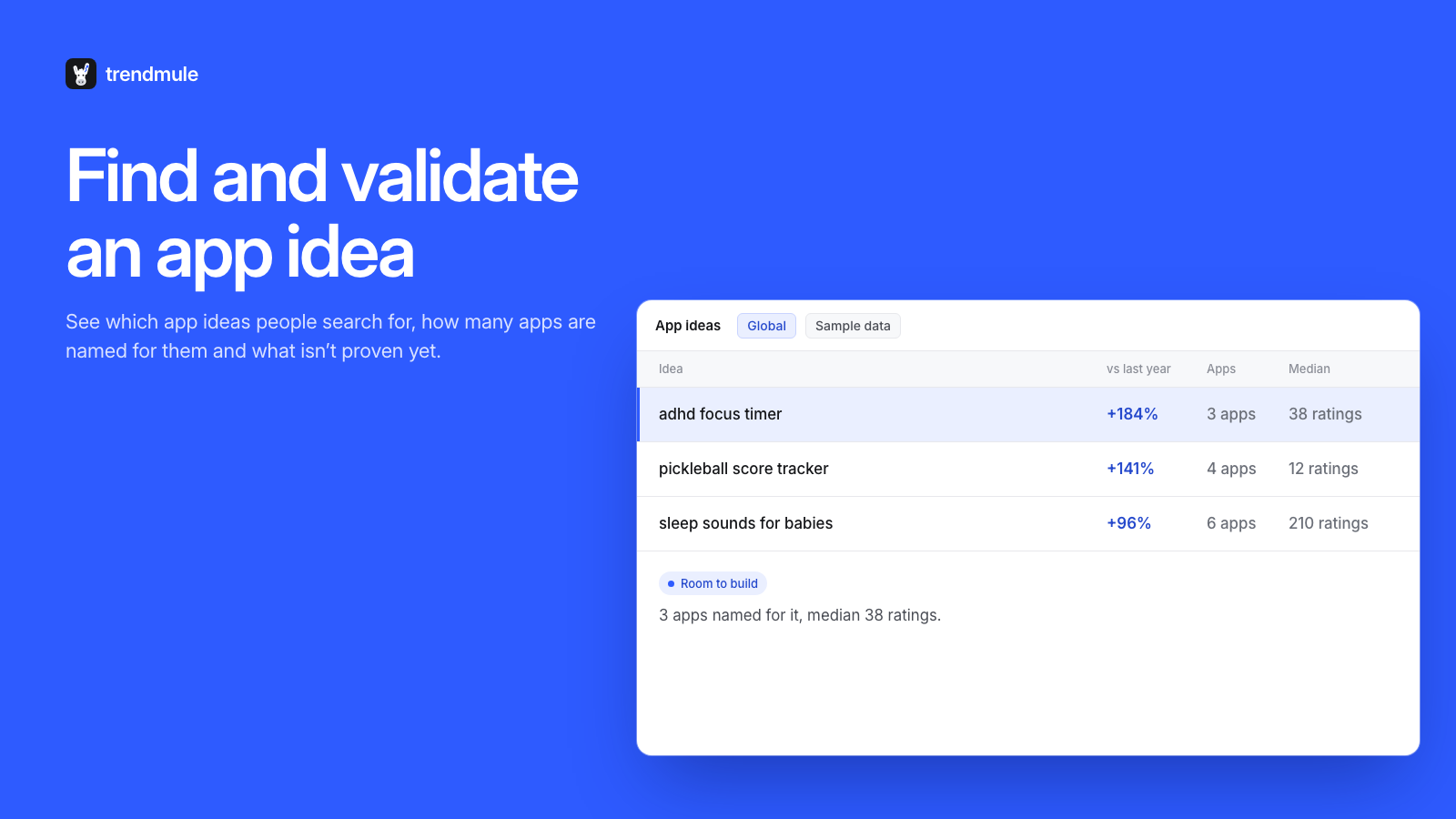
App ideas is a Trendmule list of searches that look like an app and keep rising, ranked and checked against the App Store. A search like "pickleball score tracker" describes a tool someone wants, so a climb in those searches is a climb in people looking for an app.
Each idea in the list carries four things:
- Its growth: how much the search is up on a year ago.
- Apps named for it: how many apps on the App Store are named for that search.
- How strong those apps are: shown as the median number of ratings they have.
- What isn't proven yet: a plain note when the evidence is too thin to build on.
As of October 2026, Starter shows the top 3 ideas and Pro shows up to 50. Prices and plans are on trendmule.com.
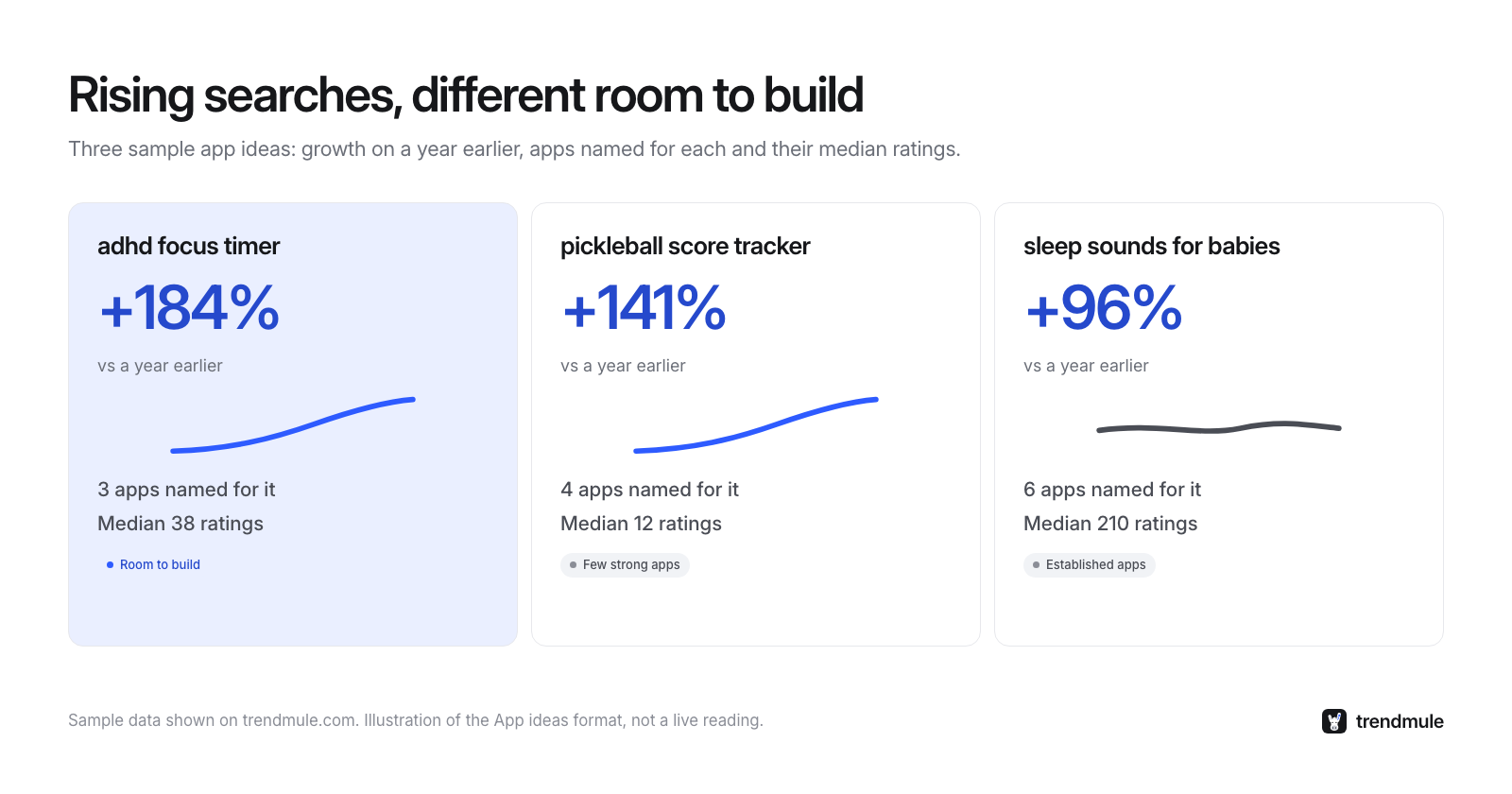
- adhd focus timer: up 184% on a year ago, 3 apps named for it, median 38 ratings. The note reads "room to build".
- pickleball score tracker: up 141%, 4 apps named for it, median 12 ratings.
- sleep sounds for babies: up 96%, 6 apps named for it, median 210 ratings.
The first two have few apps with few ratings, which is where a new app can still get noticed. The third has more apps and far more ratings, so a newcomer would be fighting established names.
How do you validate an app idea with App ideas, step by step?
Validating an idea means checking, in order, that people search for it, that the searches are growing and that the room to build is real. In App ideas that looks like this:
- Pick your market. Choose a country, or Global, so the ideas reflect the people you'd sell to.
- Read the growth. An idea that's up strongly on a year ago has more people searching for it than it did a year earlier.
- Read the apps named for it. Few apps means less to compete with. Many apps means the idea is proven but crowded.
- Read how strong those apps are. A low median rating count means the apps that exist haven't built a following yet. A high one means they have.
- Read the "not proven yet" note. If it's there, wait. More on this below.
- Open the search's history. A steady climb across months is a better base than a one-week spike. Starter keeps one month of history and Pro keeps up to two years.
Then test before you build: a one-page offer with a waitlist button tells you more than another week of reading. Our guide on validating a business idea covers how to run that test and set a pass mark first. If you'll send ad traffic to the waitlist, how to use cost per click to check a niche shows what a click usually costs.
How do you find a new niche for a digital product?
A new niche for a digital product is a narrow group of people searching for something that's growing and that few good products serve. App ideas finds them from the search side, so you don't have to guess where to look.
Three moves help once you have a list:
- Go country by country. A search can be rising in Germany and flat in the US. A niche nobody has served in one country is a place to start.
- Read the words people use. Related rising searches show the features people ask for, in their own phrases, which is better copy for your store page than any brief you'd write yourself.
- Start from what you already make. If you have an app or a site, the Website Tracking Tool (beta, Pro) lists the rising searches that fit it, which shows the nearest new niche to the one you serve today.
Our guide on finding a niche with rising searches covers the same method for products that aren't apps.
Do few apps on the App Store mean there's a gap?
Few apps named for a search can mean a gap, but it can also mean the idea doesn't work as an app. A search can be rising because people want an answer, a template or a website, and nobody has built an app for it because an app isn't the right shape.
That's why the number of apps is only one of the checks. A rising search with few apps and a note saying "room to build" is a stronger sign than few apps alone, and a gap is only real once you can say why no strong app has filled it yet. Write that reason down before you build. If you can't, treat the idea as unproven.
What does "not proven yet" mean?
"Not proven yet" means the rise is too recent to tell whether it will last. In Trendmule's sample, the note reads: most of the rise is the latest month, so wait for a second month before you build.
The difference is between a spike and a climb. A one-month jump can be a news story, a viral video or a season. A climb that continues across months is a habit forming. Our guide on how to read search trends shows the shapes a search can take, and when to jump on a trend and when to get off covers what to do with each.
What can App ideas not tell you?
App ideas is a screen for demand and competition, so it leaves out real parts of the decision:
- Search isn't downloads or revenue. People searching for an app may never install or pay for one.
- The check covers the App Store. If you build for Android, look at Google Play yourself before you commit.
- Ratings show how established apps are, not how good they are. A strong app with few ratings can still be hard to beat.
- Starter shows the top 3. A longer list of up to 50 ideas needs Pro, which costs more.
- A rising search may belong on a website. Some searches that look like apps are better served by a page, a template or a feature inside another product.
Use App ideas to drop weak ideas quickly, then spend your time testing the ones that remain.
What should you do next?
Open App ideas for your country, pick the idea with the strongest climb and the least established competition, and write down one reason it might fail. Then build the smallest test that could prove that reason wrong: a landing page, a waitlist and a message to the first ten people who sign up.
Questions people ask
How do you find good app ideas?
Look for searches that describe a tool, are still rising and have few established apps. Trendmule's App ideas ranks them and checks each against the App Store.
How do you check if an app idea has demand before building it?
Check that people search for it, that searches are growing, and that the climb has lasted more than a month. Then test with a waitlist page before you write code.
Is an app idea with few competitors a good sign?
Sometimes. It can mean a gap or it can mean the idea doesn't work as an app. Read how strong the existing apps are, and find the reason no one has built it.
Does App ideas cover Google Play?
No. It checks the App Store, so look at Google Play yourself if you plan an Android app.
Which Trendmule plans include App ideas?
Starter shows the top 3 ideas and Pro shows up to 50, as of October 2026. See pricing for the current plans.