5 min read
How to validate a business idea with search data
Check demand, direction, competition and willingness to pay before you spend money building anything.

Contents
To validate a business idea, check four things in order: people search for the problem it solves, those searches are still rising, you can beat what ranks today, and people will pay. Trendmule answers the first two in minutes, with every search labelled by whether it's still climbing. The last two take an afternoon of reading results and a week with a simple test offer.
Search data won't prove an idea will work. It will tell you quickly when it won't, which is the cheapest lesson in business.
Why validate a business idea with search data?
Search data shows what people want in their own words, before they've met your product. Someone typing "dog food for sensitive stomach" has the problem today, and the direction of those searches shows whether the problem is spreading.
Surveys tell you what people say they'd buy; searches show what they're already looking for. Interviews and test sales still matter, but search tells you which ideas deserve them.
How do you check demand for a business idea?
Write down the problem your idea solves the way a customer would type it, then look for it in your market:
- Pick the topic and country in Trendmule and see whether searches around your problem appear among the ones gaining speed.
- Note the exact phrases people use. Search autocomplete and "People also ask" show how customers describe the problem.
- Check related searches in the same topic: a cluster of rising searches is stronger evidence than one. How to find trending keywords walks through it.
Little search demand isn't always a no. Brand-new categories and B2B services often have few searches at first. It means you'll have to create demand rather than catch it, which costs more.
How do you check the idea is still growing?
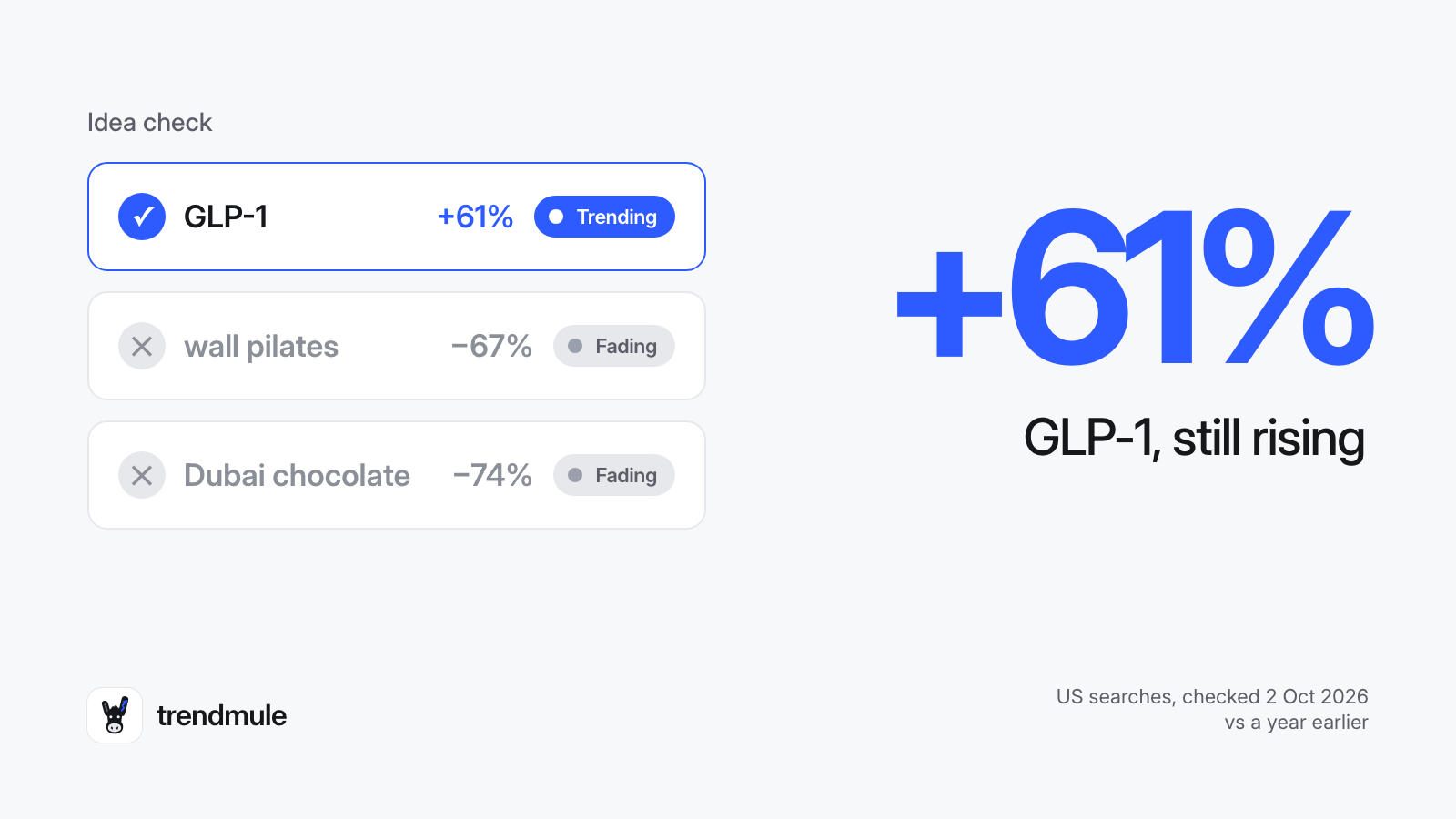
Demand that's falling is a worse bet than no demand, because the crowd you'd sell to is leaving. Trendmule labels every search: Trending means still climbing, Sticking around means holding, Always popular means steady every year, and Fading means past its best.
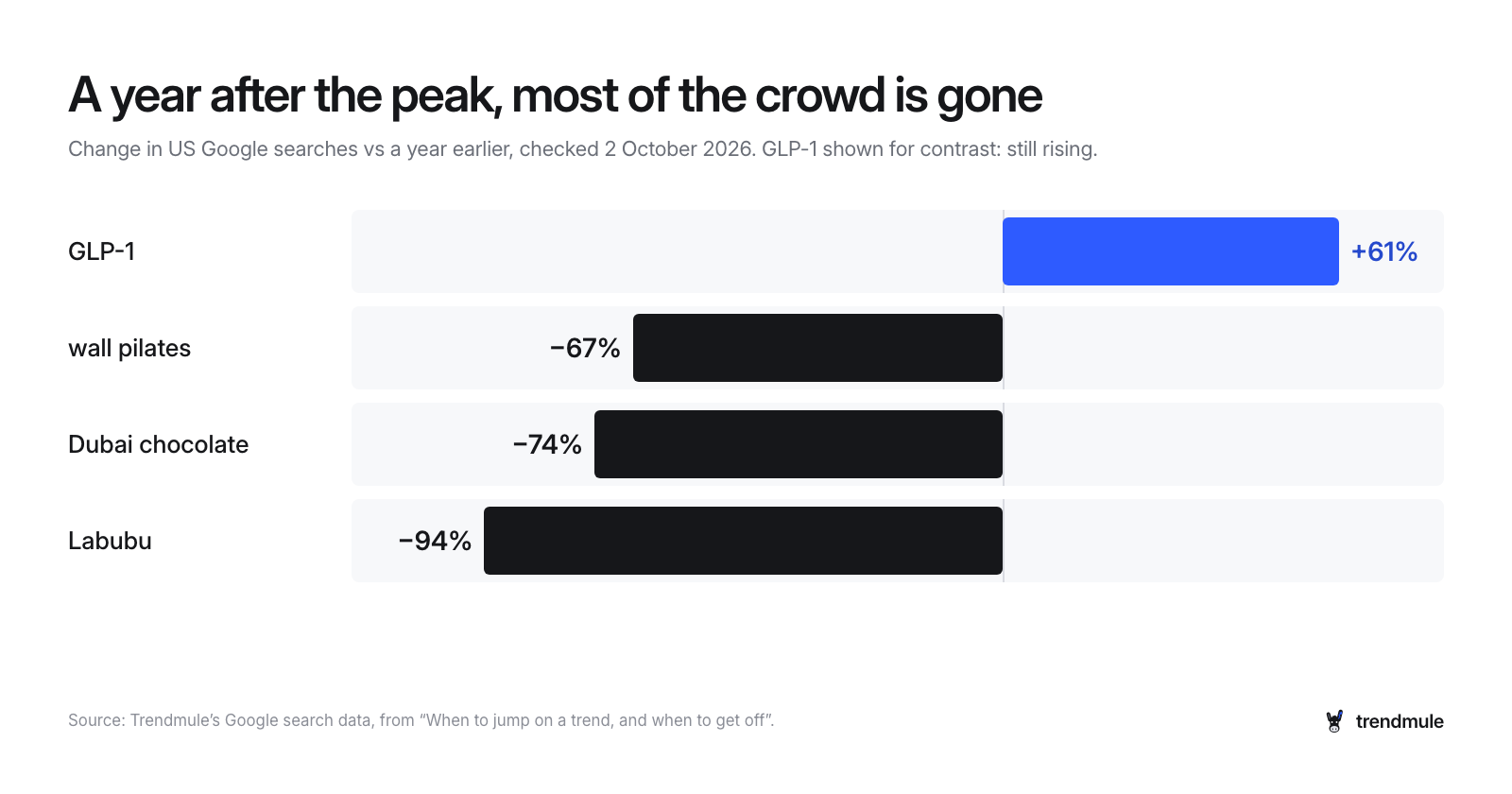
Ideas built on a peak are the most common trap. In Trendmule's Google search data checked on 2 October 2026, US searches for Labubu were down 94% on a year earlier, Dubai chocolate 74% and wall pilates 67%. Each looked like a sure thing at its top. Our guide on how to read search trends shows the four shapes a search can take.
How do you check the competition?
Search your main phrase and read page one as a customer would:
- Forums, Q&A threads and thin pages ranking means people want answers nobody has written well. That's an opening.
- Big brands and marketplaces on every result means the idea is validated, but crowded. Go narrower.
- Ads and shopping results mean people spend money on these searches, a strong sign buyers exist.
If you already have a site, Trendmule's Website Tracking Tool shows the rising searches that fit it, so you can test ideas next to what you already sell.
Building an app? Our guide on finding and validating an app idea adds a check against the App Store, so you can see who has built it already.
How do you test that people will pay?
Interest isn't a sale. The final check asks for a small commitment:
- Build a one-page offer that describes the product, its price and a button: "Pre-order", "Join the waitlist" or "Book a call".
- Send the right searches to it. A small ad budget on your main phrase, or a post where your audience already is.
- Count actions, not visits. Sign-ups, pre-orders or replies are evidence; page views are curiosity.
Decide your pass mark before you start, such as sign-ups per hundred visitors, so the result can tell you no.
What can search data not tell you?
- Margins. A rising search can belong to a product with no profit in it.
- Whether you can deliver. Demand you can't serve well goes to someone else.
- Brand-new categories. People don't search for what they don't know exists yet.
Use search data to drop weak ideas fast, then spend your time testing the strong ones. Our guide on finding a niche with rising searches helps when you don't have an idea yet, and Trendmule's plans start at $24 a month.
Questions people ask
How do you validate a business idea quickly?
Check search demand and its direction in Trendmule, read page one of the results for competition, then put up a one-page offer and count sign-ups or pre-orders over a week.
How do you validate a product idea before building it?
Search for the problem the product solves, check those searches are still rising, and test a pre-order or waitlist page. Real sign-ups before you build are the strongest evidence.
Can search data tell me if an idea will work?
No, but it tells you fast when one won't. Rising searches show growing demand; falling ones show a crowd leaving. Pair them with a small test offer before you build.
What if nobody searches for my idea?
It may be too new, or people may describe the problem differently. Try the words customers use. If there's still no search, plan to create demand through content, partners or ads.