7 min read
How to use cost per click to check a niche has demand
A click price shows whether advertisers make money in a niche. Read it next to the search trend, not on its own.

Contents
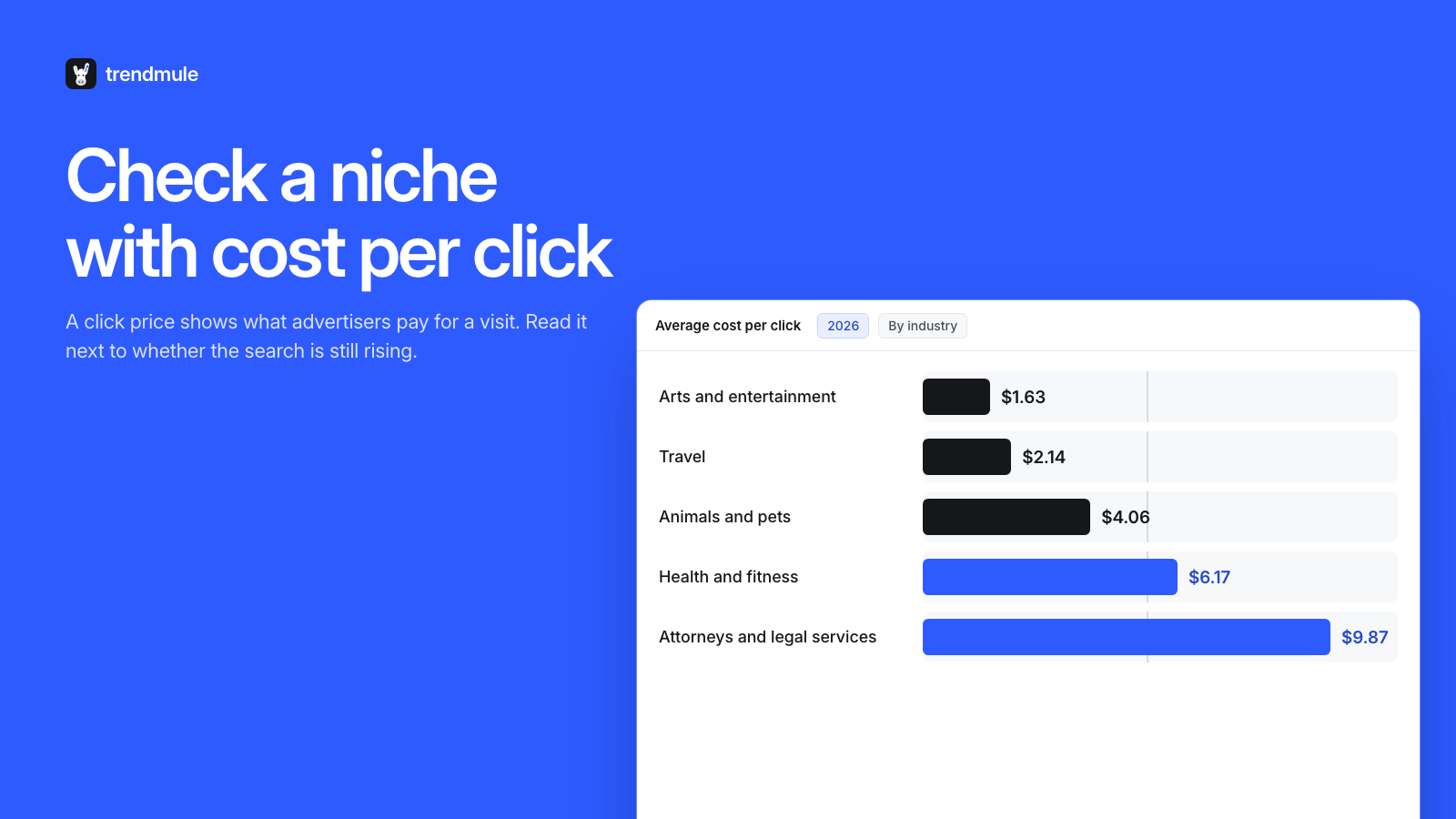
Cost per click (CPC) is what an advertiser pays each time someone clicks their ad, so it shows what a visit from that search is worth to the businesses selling there. The average across industries is $5.42 as of June 2026 (LocaliQ), and it runs from $1.63 in arts and entertainment to $9.87 in legal services. A high CPC means advertisers make money from a search. It doesn't mean you will, so read it next to whether the search is still rising.
This guide shows what a click price can tell you about a niche, how to read it with the search trend, and how to estimate what a small test would cost.
What does CPC tell you about a niche?
CPC tells you whether businesses already pay to reach the people behind a search, and roughly how much a visitor is worth to them. It shows what the market values, which is different from how many people want something.
Three things follow from a click price:
- Advertisers exist. A search with a price has businesses bidding on it, so someone believes a visit turns into revenue.
- The value of a customer. A high price points to customers worth a lot, such as a legal client. A low price points to customers worth less per visit, such as a ticket buyer.
- How hard the ad route is. A high price means paying to win traffic costs more, so a small budget buys fewer visitors.
What CPC doesn't show is how many people want the thing. A niche can have expensive clicks and a shrinking audience, or cheap clicks and a growing one.
What is a normal CPC?
A normal CPC depends on the industry. The average across all industries is $5.42, and these are the averages for eight categories in the same 2026 report, which analyses search advertising campaigns:
- Arts and entertainment: $1.63
- Travel: $2.14
- Sports and recreation: $2.77
- Animals and pets: $4.06
- Beauty and personal care: $4.62
- Health and fitness: $6.17
- Home and home improvement: $8.33
- Attorneys and legal services: $9.87
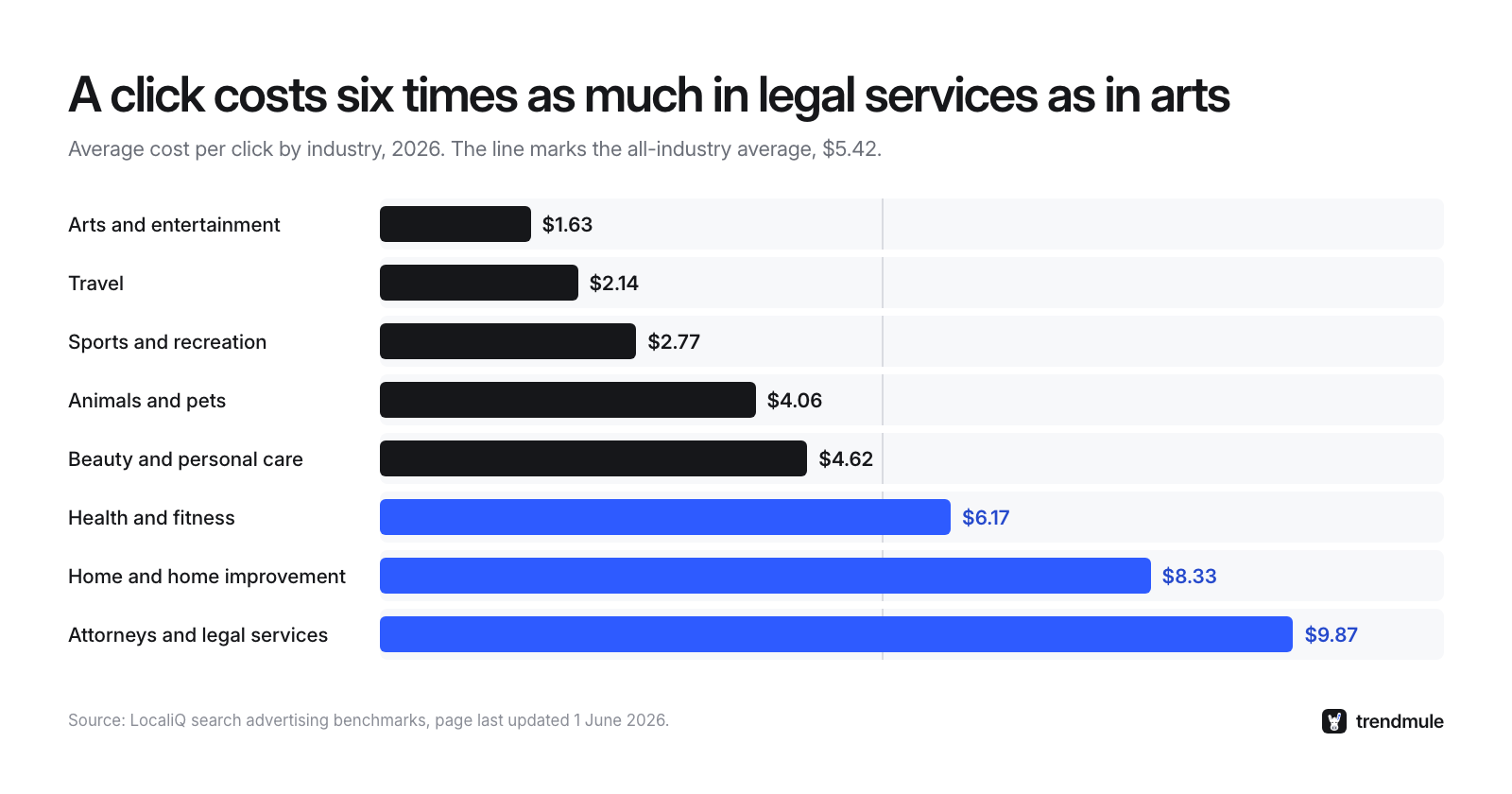
These are averages over many campaigns. A single keyword can sit far above or below its industry, so the benchmark tells you what range to expect, and the keyword's own price tells you what you'd actually face.
How do you turn CPC into a demand check?
Read the click price together with the direction of the search. Price shows what the market pays, and direction shows whether the audience is growing. Together they give four readings:
- Rising, with a high click cost: advertisers are paying more for a growing audience. The demand and the money are both real, but the ad route is crowded, so go narrower or lead with content.
- Rising, with a low click cost: the crowd may not have arrived yet, or a visit may be worth little. Test with a small budget to find out which.
- Flat or fading, with a high click cost: advertisers are paying for an audience that's shrinking. Being the last to arrive is the most expensive position.
- Fading, with a low click cost: little demand and little money. Move on.
Our guide on how to read search trends explains how to tell a rising search from a fading one before you apply this.
What does a click cost reading look like in Trendmule?
Trendmule, a dashboard of rising Google searches, puts the price beside the trend for each search. In the Website Tracking Tool, which is in beta on the Pro plan as of October 2026, every rising search that fits your site comes with an ads plan. The plan shows what a click costs, how crowded the search is and which keywords to bid on.
A reading for one keyword then has four parts:
- Direction: its label (Trending, Sticking around, Always popular or Fading) and its change on a year ago.
- What a click costs: the price for that keyword.
- How crowded it is: how much competition there is for it.
- Whether you rank for it: if your site already appears for it, or if it's a page to make.
This is a keyword-level reading, not an industry average. A benchmark tells you what a legal or fitness click usually costs, and the reading tells you what this click costs, next to whether its audience is growing.
How do you estimate what a test would cost?
Divide your test budget by the click price to see how many visitors it buys, then apply a sign-up rate you choose. Here's an example with a $500 budget, using three prices from the report above. The 3 in 100 sign-up rate is an assumption for the example, so replace it with your own.
- At $1.63 a click (arts and entertainment): about 307 visitors, around 9 sign-ups, roughly $54 each.
- At $5.42 a click (the all-industry average): about 92 visitors, around 3 sign-ups, roughly $181 each.
- At $9.87 a click (legal services): about 51 visitors, around 2 sign-ups, roughly $329 each.
The sign-up cost is the click price divided by the sign-up rate, so it moves with both. This is an example, not a forecast. Use the keyword's own price where you have it, and set the pass mark before you spend, as in our guide on validating a business idea.
Does a high CPC mean a niche is good?
A high CPC doesn't mean a niche is good. Attorneys and legal services pay $9.87 a click and arts and entertainment $1.63, about six times as much, because a legal client is worth far more than a ticket buyer. The price reflects what a customer is worth to advertisers, not how easy the niche is to win.
What matters is the gap between the click price and what a customer is worth to you. A $9.87 click is a bargain if a customer pays you thousands, and a loss if a customer pays you $20. Before you pick a niche on its click price, work out what one customer is worth and how many clicks it takes to find one.
What can CPC not tell you?
CPC is one signal, and it has limits that matter for a niche check:
- Not every search has a price. Brand-new categories and purely informational searches may have no advertisers, so a missing price doesn't mean no demand.
- Averages hide the keyword. A keyword can sit far from its industry's average, so a benchmark is a starting range, not a quote.
- Prices move. They change with season and competition, so date every figure and re-check it before you spend.
- A price isn't an audience. It says what advertisers pay, not how many people want the product, which is what direction shows.
Use CPC to judge how hard and how valuable the ad route is, and use the search trend to judge whether the audience is growing.
What should you do next?
Pick three keywords for your niche. For each, write down its direction and its click price, then place it in one of the four readings above. Drop the ones that are fading with high prices, and test the rising ones with a small budget. Our guides on finding trending keywords and keyword research for small business cover how to build the list. Building an app? Our guide on how to find and validate an app idea adds the App Store side of the check.
Questions people ask
What is CPC?
CPC, or cost per click, is the amount an advertiser pays each time someone clicks their ad. It shows what a visit from a search is worth to the businesses bidding on it.
What is a good CPC?
It depends on the industry. The average across industries is $5.42 as of June 2026, from $1.63 in arts and entertainment to $9.87 in legal services (LocaliQ).
How do you use CPC to check demand for a keyword?
Read the click price beside the search's direction. A rising search with real click costs shows demand and money. A fading one with high costs shows a shrinking audience.
Does a high CPC mean high demand?
No. A high CPC means customers are worth a lot to advertisers. It doesn't show how many people want the product, so check whether the search is rising too.
How do you estimate an ad budget from CPC?
Divide your budget by the click price to get the visitors you can buy. Then apply the sign-up or sale rate you expect to see what each result costs.
Which Trendmule plan shows what a click costs?
The Website Tracking Tool shows it for each rising search that fits your site. It's in beta on the Pro plan as of October 2026. See pricing.