5 min read
How to find low-competition keywords that are still rising
Easy to rank for is only half the check. Here's how to find low-competition keywords whose searches are growing, with real US examples.


Contents
To find low-competition keywords worth targeting, filter for a low difficulty score first, then keep only the ones whose searches are still rising. Low competition alone isn't enough: of 145 low-difficulty US product and food searches in Trendmule's analysis of Google search data for August to October 2026, 18 had fallen by a quarter or more on a year earlier. Padel racket (up 171%, difficulty 2) is the kind to target. Barn jacket (down 37%, difficulty 0) is the kind to skip.
A keyword is often easy because people stopped searching for it.
What is a low-competition keyword?
A low-competition keyword is a search where the pages on Google's first page are weak: few links pointing to them, thin answers or forum threads. It's different from a low-volume keyword, which just has few searches. A keyword can be low in competition and still searched thousands of times a month.
Most SEO tools score this as keyword difficulty, from 0 to 100. The lower the score, the easier page one should be, and many people treat anything under about 15 as easy. The score is an estimate of how hard ranking is, not a promise.
How do you find low-competition keywords?
- Start from your topic and list the searches around it: what your customers type, the questions in Google's "People also ask" box, autocomplete suggestions.
- Check each one's difficulty in a keyword tool and keep those under about 15.
- Search each one yourself. If page one has Reddit threads, forum posts or pages that don't answer the question, there's room.
- Check the search's direction over a year, and drop anything shrinking. This is the step most guides skip.
- Match each keyword to one page, so you don't compete with yourself.
Our guide on keyword research for small business covers steps 1 to 3 and 5 in detail.
Why do low-competition keywords need a trend check?
A keyword often has low competition because its moment passed and the strong pages moved on. Writers chase what's rising, so a search that peaked a year ago has few fresh pages. It looks like an opening. It's a shrinking audience.
These six had difficulty scores of 6 or less in November 2026, and every one was down on a year earlier in US searches:
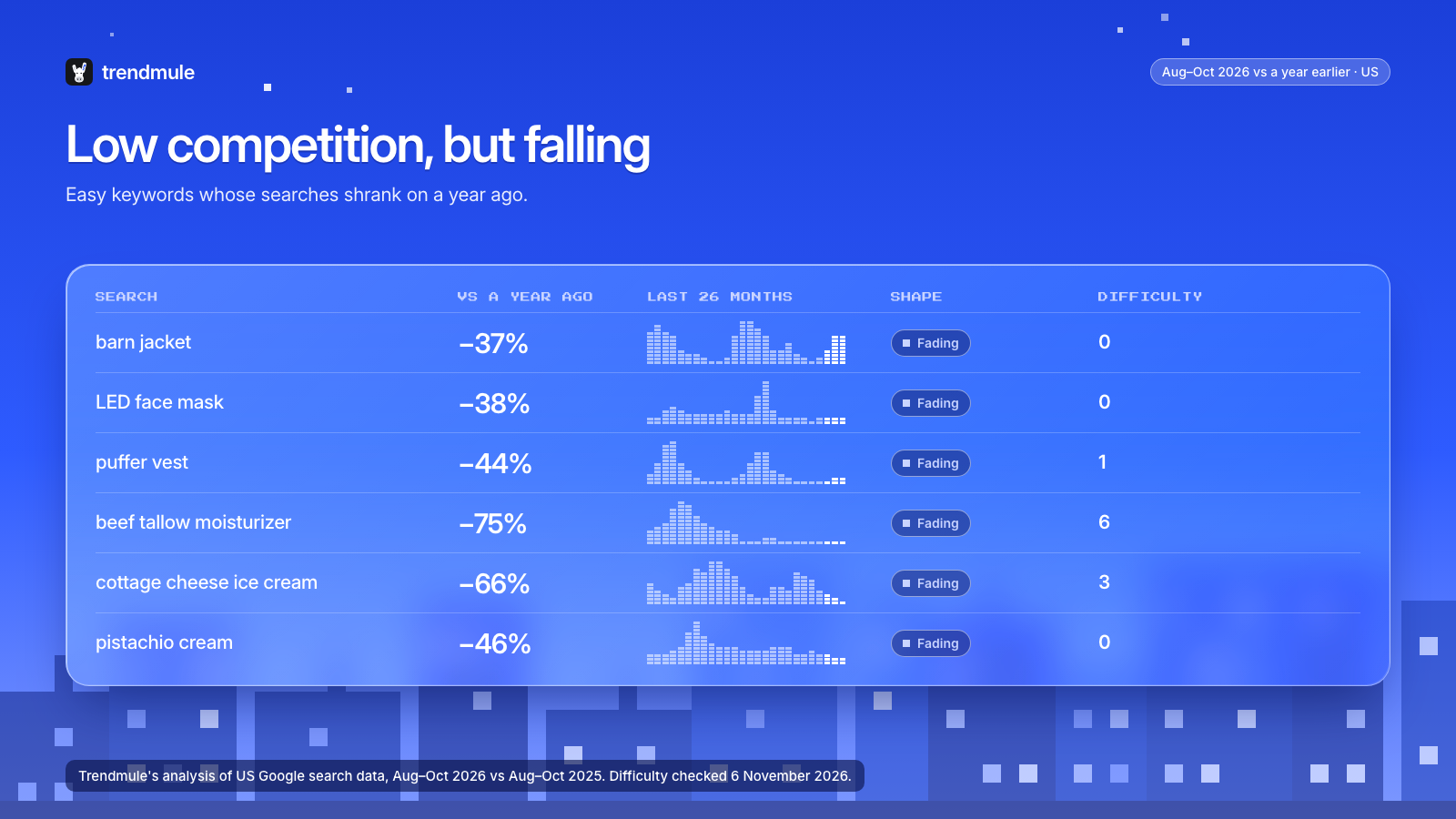
- Beef tallow moisturizer: down 75% and cottage cheese ice cream: down 66%.
- Pistachio cream: down 46% and puffer vest: down 44%.
- LED face mask: down 38% and barn jacket: down 37%.
Ranking first for a search that halves every year gets you less traffic every month you hold the spot.
Which low-competition keywords are still rising?
These eight had difficulty scores of 13 or less and grew on a year earlier, in US Google searches for August to October 2026:
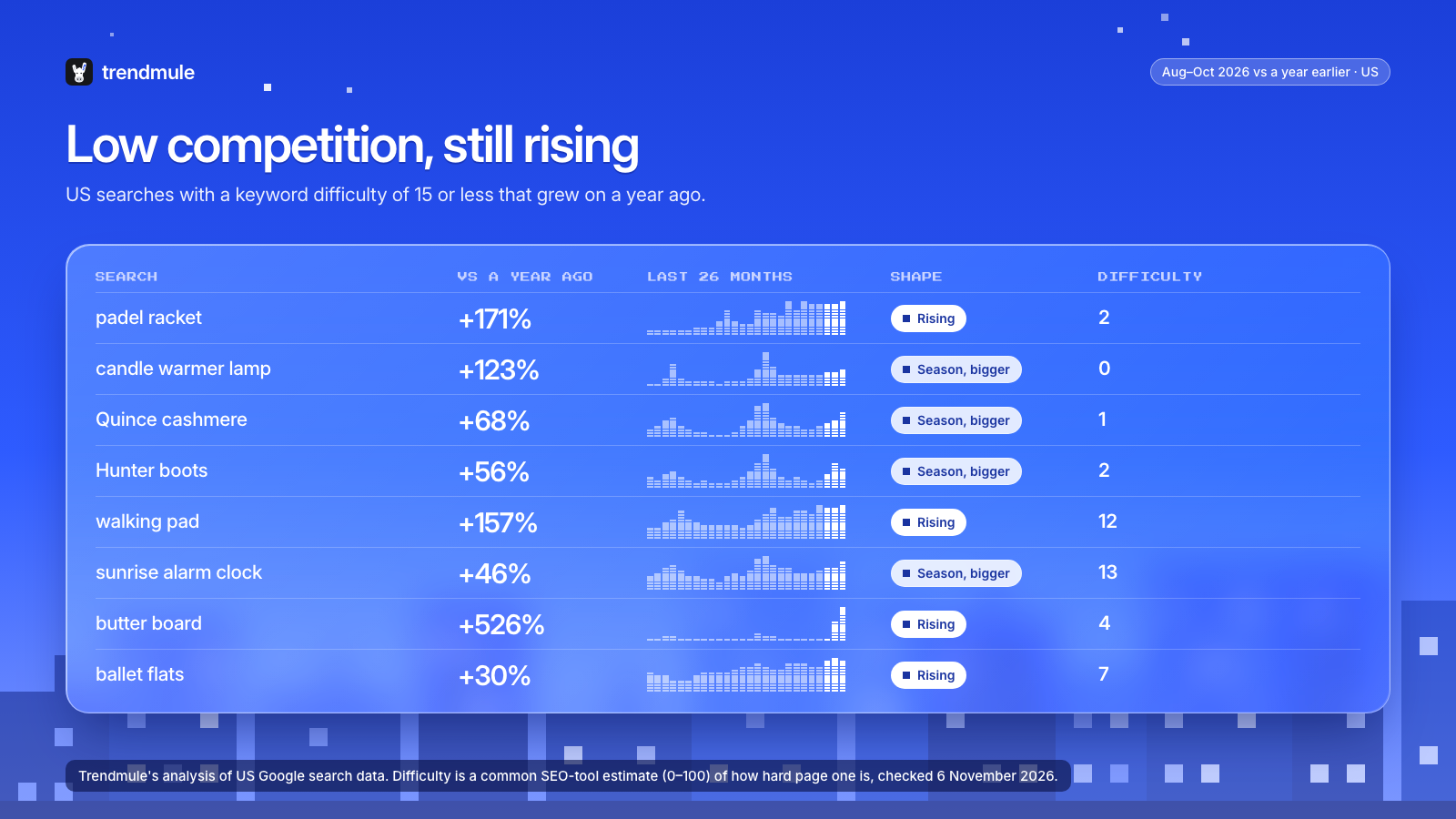
- Butter board: up 526%, difficulty 4. Very recent, so watch it holds.
- Padel racket: up 171%, difficulty 2.
- Walking pad: up 157%, difficulty 12.
- Candle warmer lamp: up 123%, difficulty 0. Seasonal, but bigger than last year.
- Quince cashmere: up 68%, Hunter boots: up 56% and sunrise alarm clock: up 46%.
- Ballet flats: up 30%, difficulty 7.
These are the keywords to build pages for now: easy to win and growing, so a page that ranks gets more visits each month, not fewer.
How do you find rising low-competition keywords faster?
Flip the order: start from what's rising, then check difficulty. A list of rising searches is short; a list of easy keywords is endless. Checking 30 rising searches for difficulty takes minutes.
Trendmule is a dashboard of rising Google searches for creators and app makers. Pick a country and a topic, and it lists the searches gaining speed there, each labelled by whether it's still climbing. On Pro, the Website Tracking Tool starts from your site and shows the rising searches in your niche that you don't rank for yet.
Our guide on how to find trending keywords covers the rising side step by step.
What are the limits of low-competition keywords?
- Difficulty is an estimate. Different tools score the same keyword differently, and none of them sees Google's ranking signals directly.
- Rising keywords attract writers. A keyword that's easy and rising today won't stay easy for long, so speed matters.
- Small keywords stay small. Many easy keywords are easy because few people search for them, so you need many pages to add up.
Whether a keyword is worth it depends on your site: a new site needs easy and rising; an established site can take on bigger, harder searches.
Questions people ask
How do I find low-competition keywords for free?
Use Google autocomplete, "People also ask" and forum threads to list ideas, then search each one and look for weak pages on page one. Check direction in Google Trends before you write.
What keyword difficulty is considered low?
Most people treat a score under about 15 out of 100 as low. It's an estimate, so check page one yourself before you commit.
How do I find high-volume, low-competition keywords?
Look for searches that grew recently: demand arrived before the strong pages did. Padel racket searches grew 171% in the US while difficulty stayed at 2.
Are low-competition keywords worth targeting?
Yes, if their searches are stable or rising. A low-competition keyword that's shrinking gets you less traffic every month, even at the top.