5 min read
Free market research tools to check demand before you build
Seven free tools, the one question each answers, and the order to use them in before you spend money on a product, an app or a shop.
Contents
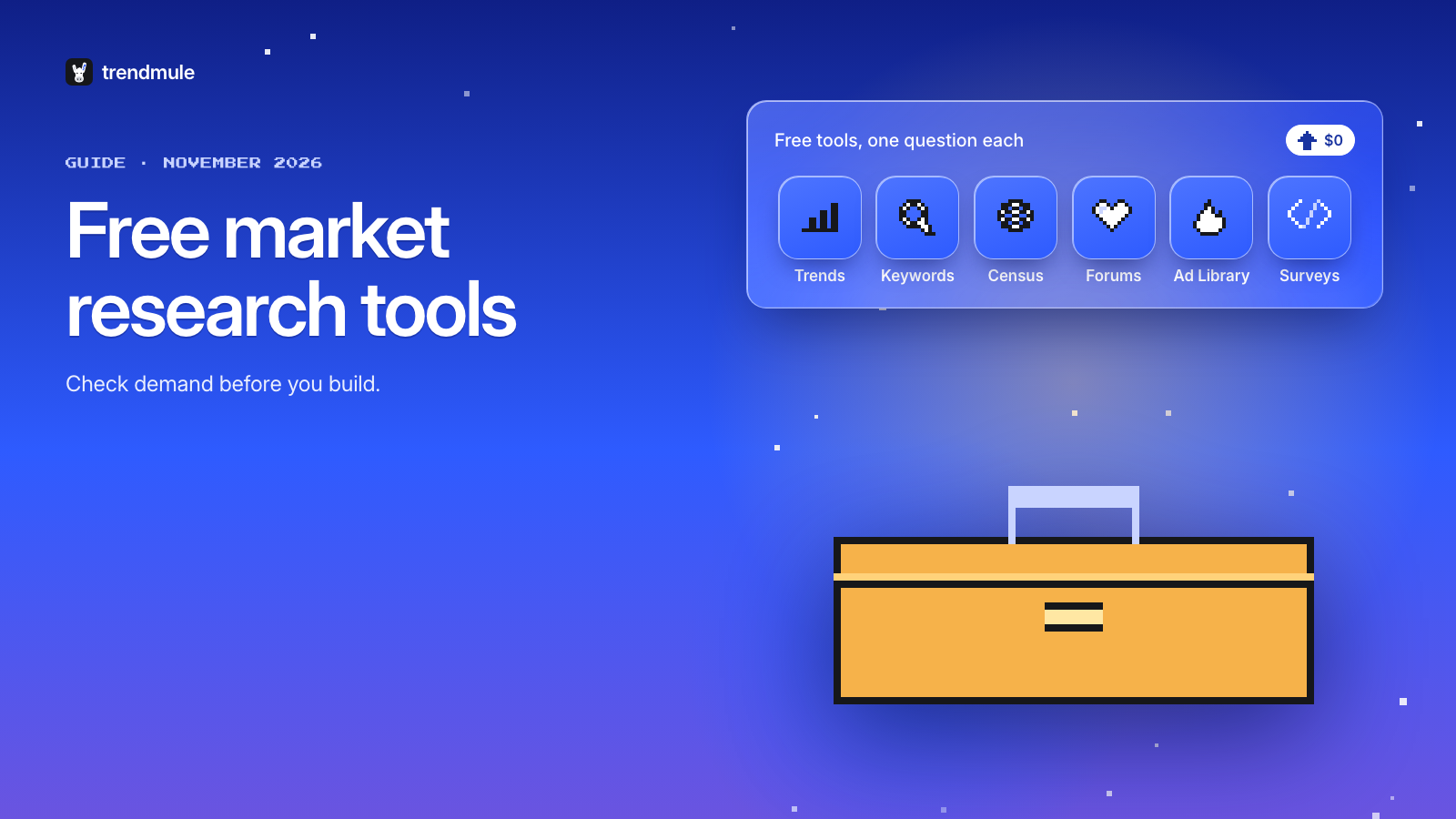
The free market research tools that check demand before you build are Google Trends, Google Keyword Planner, the U.S. Census Business Builder, Reddit, the Meta Ad Library, Google Forms and Amazon Best Sellers. Each answers one question: whether interest is growing, how many people search, who lives in a market, what buyers complain about, who already advertises, whether people say yes, and what sells now. Used in order, they take about a day and cost nothing.
None of them alone tells you if an idea will work. Together, they tell you if it's worth testing.
Which free market research tools should you use?
Pick tools by the question you need answered, not by how many features they have. These seven, plus one paid tool, cover the questions that decide most product, app and shop ideas:
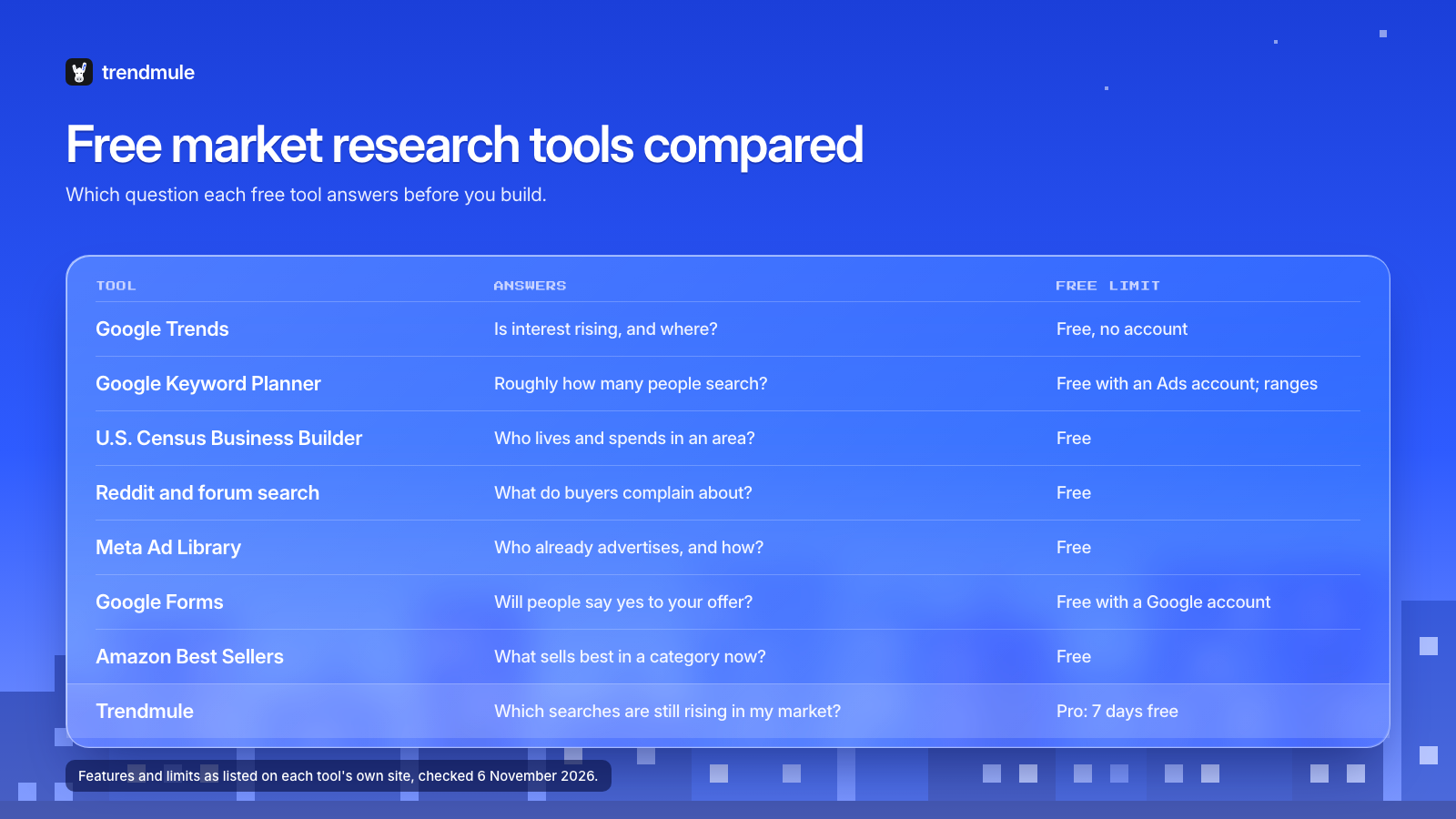
- Google Trends: is interest rising, and where? Free, no account. Shows interest from 0 to 100 over time and by region, not search counts. Where to get real search numbers explains the gap. Our guide on how to use Google Trends covers how to read it.
- Google Keyword Planner: roughly how many people search? Free with a Google Ads account. Accounts that don't run ads often see ranges instead of exact numbers.
- U.S. Census Business Builder: who lives and spends in an area? Free. Population, income and business counts by place, for local and US-wide ideas.
- Reddit and forum search: what do buyers complain about? Free. Search your topic plus "worst", "alternative" or "recommend" to find the problems people pay to solve.
- Meta Ad Library: who already advertises, and how? Free. Shows the ads running on Facebook and Instagram, so you see competitors' offers and how long they keep an ad.
- Google Forms: will people say yes to your offer? Free with a Google account. A five-question survey sent to the right people beats a hundred opinions.
- Amazon Best Sellers: what sells in a category now? Free. Rankings by category, updated often, which shows what's selling rather than what's searched.
- Trendmule: which searches are still rising in my market? Paid, with a 7-day free trial of Pro, as of November 2026. Lists the searches gaining speed in a country and topic, each labelled by whether it's still climbing.
In what order should you use them?
- Direction first. Check whether interest in your idea is growing, flat or falling. A falling market makes every later step harder.
- Size next. A rising search with almost no volume can't carry a business on its own.
- Money. Check what advertisers pay per click and who already runs ads. Our guide on using cost per click to check a niche explains what the price tells you.
- Words. Read forums and reviews to learn the problem in buyers' language.
- Test. Ask real people with a survey or a one-page waitlist.
Our guide on how to validate a business idea walks through step 5.
Why is direction the check most people skip?
Most free tools show how big a market is today, which says little about where it's going. A big, flat market is already served by whoever got there first. A small market that's growing fast is where a newcomer can still win.
In Trendmule's analysis of US Google search data for August to October 2026, walking pad searches were up 157% on a year earlier while Dubai chocolate, still a much larger search, was down 48%. A size-only check would have pointed you at the wrong one. Our list of trending products in the US right now shows more examples.
Where do free market research tools stop?
Free tools answer one question each, one term at a time. That's fine for checking a single idea, and slow for finding one. Comparing 50 possible products in Google Trends means 50 charts, and none of them tells you which is rising, which is a season and which is fading.
Trendmule is a dashboard of rising Google searches for creators, app makers and small businesses. It starts from a country and a topic, lists the searches gaining speed there with their volume, growth and click cost, and labels each one by shape. Pro adds App ideas checked against the App Store and two years of history, as of November 2026.
What can't free tools tell you?
- Willingness to pay. Searches, posts and survey answers show interest. Only a pre-order, a deposit or a paid test shows people will pay.
- Your margins. No demand tool knows your costs, so a busy market can still be a bad business.
- What happens next month. Every tool here shows the past, up to a few weeks ago.
How much research is enough depends on what you're risking: an afternoon for a blog post, a week for a product you'll stock.
Questions people ask
What is the best free market research tool?
It depends on your question. Google Trends shows if interest is rising, Keyword Planner shows roughly how many search, and Reddit shows what buyers say. Most ideas need all three.
How do I do market research for free?
Check direction in Google Trends, size in Keyword Planner, buyers' words on Reddit and competitors in the Meta Ad Library, then test with a Google Forms survey or a waitlist.
Is Google Trends good for market research?
Yes, for direction. It shows whether interest is growing and where, but not how many people search or whether they buy.
How do I check if there is demand for a product?
Look for rising searches, a real click cost and competitors who keep advertising. Then ask buyers to pre-order or join a waitlist before you build.